
Average 5K Time
Enter your sex, age and time to see how a 5K compares with other road-race finishers.
Free · runs in your browser · nothing is uploaded
Recent
Your last 10 settings, saved only in this browser. Nothing is uploaded.
This average 5k time page shows the typical finish time for 5K road races, split by sex and age group, and places your own time against it. Across 113,571 road-race finishers in Switzerland from 1999 to 2019, the median 5K time was 0:29:57: 0:27:06 for men and 0:31:41 for women. These are finishers of road races in one country, not all runners, and fun runs and races in other countries will differ. Enter your sex, age and time to see where you fall.
Use the tool below by entering your sex, age and 5K time, or leave the time blank to read the figures for your group alone. The page also shows how the middle 50 % and the fastest 10 % of finishers compare with the median.
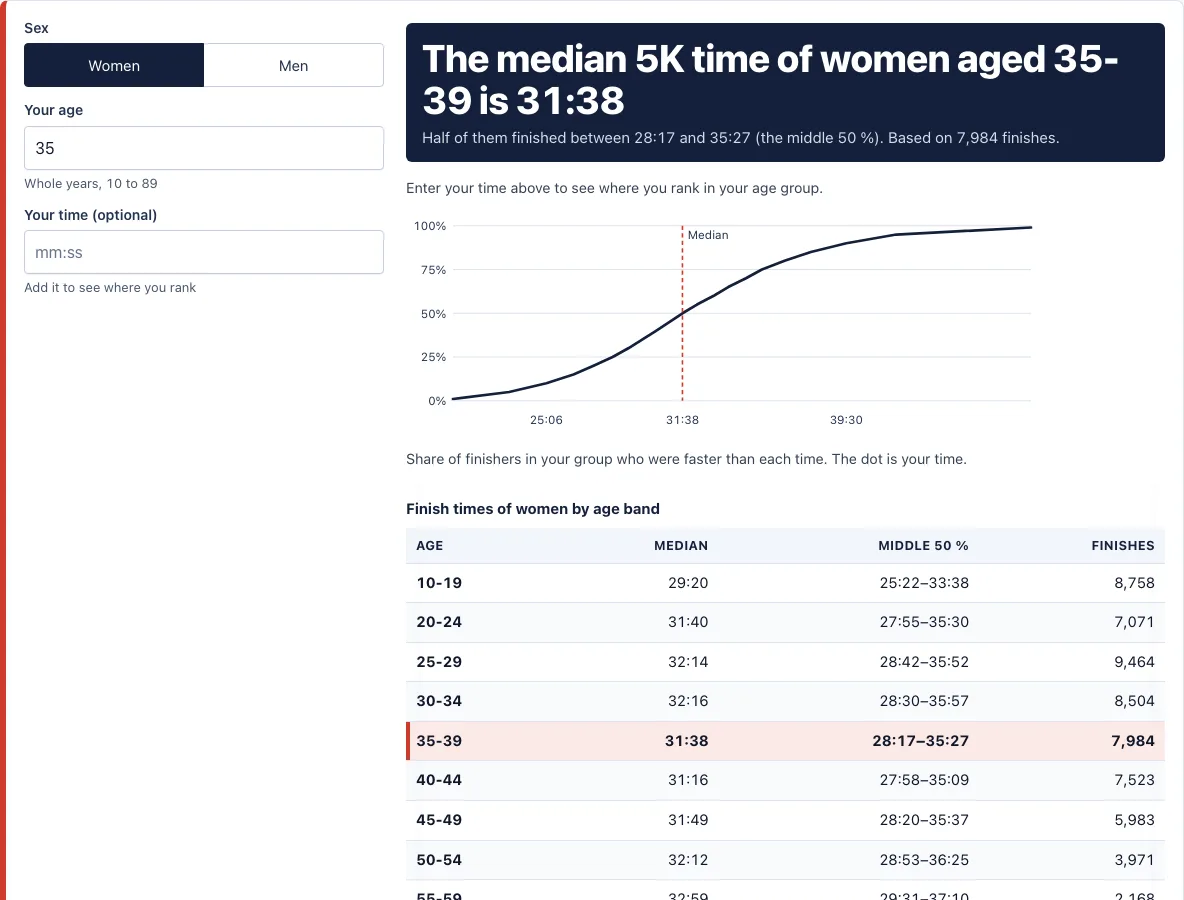
How to use the average 5k time tool
- Choose Women or Men. The median and the middle 50 % change with the group you pick.
- Enter your age, from 10 to 89. The tool uses the age band that contains it.
- Optionally enter your 5K finish time. Leave it blank to see only the group figures.
- Read the median and the middle 50 % for your group. The middle 50 % is the range from the 25th to the 75th percentile finish time.
- If you entered a time, read the share of finishers you were faster than. This is a position within the dataset, not a score.
- Read your age-grade percentage. It compares your time with the standard for your sex and age, using the USATF MLDR / Alan Jones road age-grading tables (2025, CC0 data).
- Check the chart and the tables by age band. The 5K page also lists the times for 60, 70 and 80 % age grade for your sex and age.
The figures are our own statistics from the open Swiss road-race dataset of Witthöft et al., PLOS ONE 2025 (CC BY 4.0), covering 1999 to 2019 and finishers only. Read them as figures for road-race finishers in one country, not for all runners. Age grades use the USATF MLDR / Alan Jones road age-grading tables (2025). The tool runs in your browser, nothing you enter is uploaded, and it is free.
Reading the result well. Compare yourself with your own sex and age band first, because the all-ages median mixes groups that run at very different speeds. Treat one race as one data point: course, weather and the day you had all move a finish time. If you want a target rather than a position, pick a time from the age-grade list and use the race pace calculator to turn it into a pace for each kilometre or mile.
What is the average 5K time?
The median 5K finish time across all finishers is 0:29:57, and the mean is 0:30:10. The middle 50 % ran between 0:25:29 and 0:34:24. This page reports the median because a small number of very slow times pull the mean upward.
What is a good 5K time?
This page defines good by age-grade percentage, not by opinion. For a man aged 45, a 5K in 0:23:25 gives 60 %, 0:20:04 gives 70 % and 0:17:33 gives 80 %. For a woman aged 45, the same three marks are 0:25:31, 0:21:52 and 0:19:08.
How long does it take to run a 5K?
Half of the finishers ran faster than the 0:29:57 median. The fastest 10 % finished in 0:21:46 or less, and the slowest 10 % took longer than 0:38:32. Eighty percent of finishers fall between those two marks.
How does the average 5K time change with age?
Medians move with age, though not in a straight line. Men’s medians are 0:25:12 at 20 to 24, 0:27:32 at 30 to 34, 0:28:23 at 50 to 54 and 0:30:05 at 60 to 64. Women’s medians are 0:31:40 at 20 to 24, 0:32:16 at 30 to 34, 0:32:12 at 50 to 54 and 0:34:06 at 60 to 64.
Why the median and not the mean?
A few very slow finishes pull the mean above the median, so the median describes the typical finisher better. Half of the finishers ran faster than the median and half ran slower. The page also shows the 25th and 75th percentile times. Together they give the middle 50 %, the range in which half of all finishers ended up, so you can see how wide “normal” is for your group before you judge your own time.
What these figures can and cannot tell you
The numbers come from finishers of organised road races in one country between 1999 and 2019. They leave out runners who did not finish, runners who never enter races, and any race outside that dataset. A median from this data is a fair picture of road-race finishers in that period, not a rule for every runner in every country. If your time sits below the median for your group, that says nothing about your health or your potential: a position in a table is not a score of how well you trained.
How wide is the spread of 5K times?
The spread is large. The fastest 10 % of all finishers ran 0:21:46 or less, while the slowest 10 % took longer than 0:38:32, which is a gap of more than sixteen minutes between the two marks. Among men the fastest 10 % ran 0:19:58 or less and the slowest 10 % took longer than 0:36:45. Among women the same marks are 0:24:42 and 0:39:28. Because the spread is wide, a time a few minutes above or below the median is still well inside the normal range.
How this tool works and where the numbers come from
Medians and percentiles are our own statistics computed from the open Swiss road-race dataset of Witthöft et al. (PLOS ONE 2025, CC BY 4.0): road races in Switzerland from 1999 to 2019, finishers aged 10 to 89, 5K. They describe finishers in one country, not all runners. The share of finishers faster than your time is interpolated between stored percentiles. Age grade uses the 2025 road tables of Alan Jones / USATF MLDR (CC0).
Sources
Frequently asked questions
What is the average 5K time for women?
The women’s median for all ages is 0:31:41, and the middle 50 % runs from 0:28:01 to 0:35:37. The 40 to 44 band has a median of 0:31:16.
What is the average 5K time for men?
The men’s median for all ages is 0:27:06, and the middle 50 % runs from 0:22:58 to 0:32:03. The 40 to 44 band has a median of 0:26:55.
Is there an average 5K time for beginners?
The dataset records sex and age for finishers, but not how long each runner has been training, so it cannot give a beginner figure. A more useful target for a new runner is an age-grade percentage. Start with the 60 % time for your sex and age.
What is a decent 5K time?
A decent time depends on your age and sex, so this page uses the age-grade percentage. A 60 % age grade is the start of the local level, and 70 % is the start of the regional level.
What is a fast 5K time?
The fastest 10 % of all finishers ran 0:21:46 or less. That cut covers all ages and both sexes together, so an older runner can be fast for their age at a slower time.
What is a good 5K best time?
The dataset holds medians and percentiles, not records. The fastest 10 % of all finishers ran 0:21:46 or less, which is one way to read a strong time.
What share of finishers ran a 5K in under 30 minutes?
Across all ages and both sexes, about 50 % of finishers ran faster than 0:30:00, which matches the median of 0:29:57. In the same data, a woman who ran under 0:25:00 was faster than 89 % of women finishers. The men’s median is lower, so the same time places a man differently; enter your sex to see your own position.
Does the average 5K time rise a lot with age?
Slowly. The men’s median goes from 0:25:12 at 20 to 24 to 0:30:05 at 60 to 64. The women’s median goes from 0:31:40 at 20 to 24 to 0:34:06 at 60 to 64. The rise is gradual rather than a sudden drop, and the age-grade percentage on this page corrects for it.
Related tools
- Average 10K time: Use this to compare a 10K time by age and sex.
- Average half marathon time: Use this to see how common each half marathon goal is.
- Average marathon time: Use this for the marathon average and the pace for each group.
- Age grade calculator: Use this to turn any race time into an age-graded percentage.
- 5K training plan: Use this to build a plan for a faster 5K.
- 5K pace chart: Use this to see split times for your goal 5K time.