
Boston Marathon Qualifying Times Calculator
See your Boston qualifying standard for 2027 and how far your marathon time is from it.
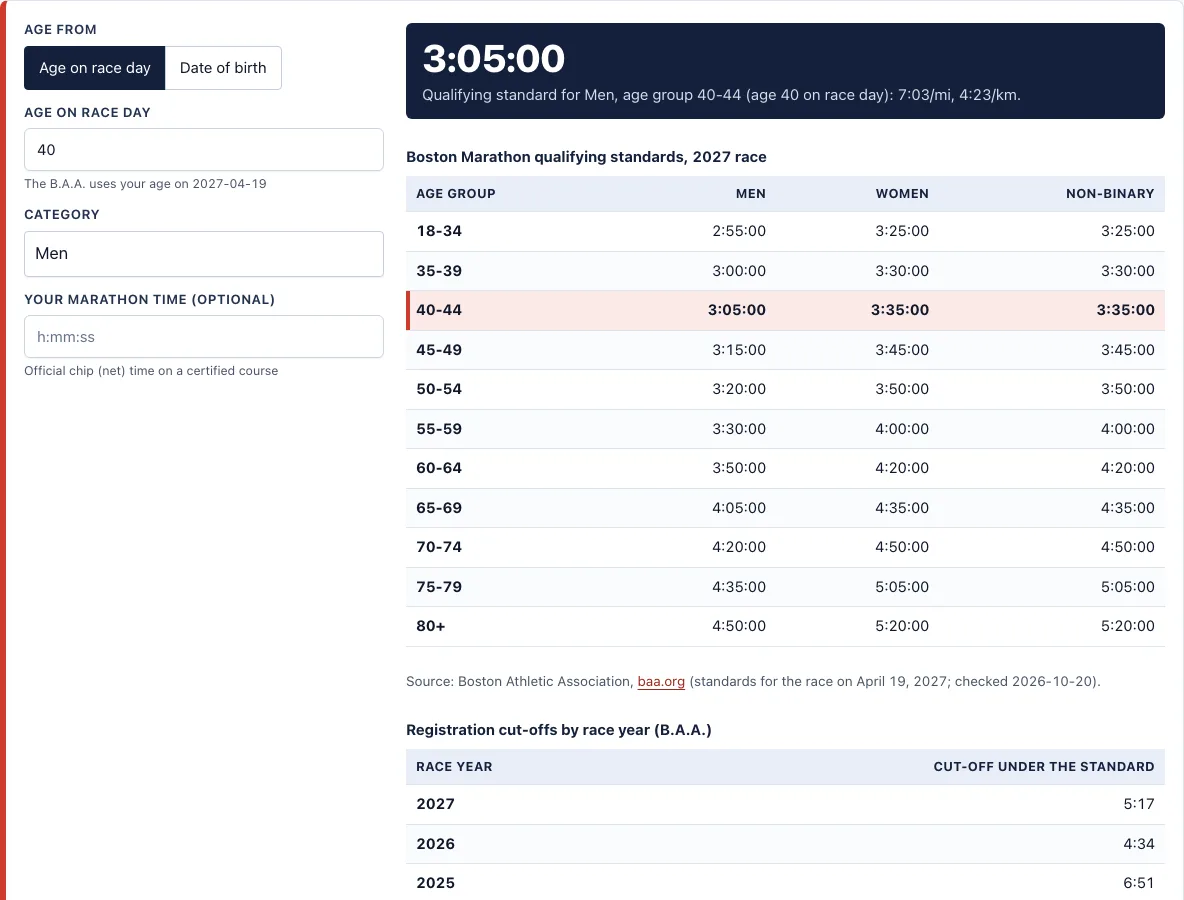
| Age group | Men | Women | Non-binary |
|---|---|---|---|
| 18-34 | 2:55:00 | 3:25:00 | 3:25:00 |
| 35-39 | 3:00:00 | 3:30:00 | 3:30:00 |
| 40-44 | 3:05:00 | 3:35:00 | 3:35:00 |
| 45-49 | 3:15:00 | 3:45:00 | 3:45:00 |
| 50-54 | 3:20:00 | 3:50:00 | 3:50:00 |
| 55-59 | 3:30:00 | 4:00:00 | 4:00:00 |
| 60-64 | 3:50:00 | 4:20:00 | 4:20:00 |
| 65-69 | 4:05:00 | 4:35:00 | 4:35:00 |
| 70-74 | 4:20:00 | 4:50:00 | 4:50:00 |
| 75-79 | 4:35:00 | 5:05:00 | 5:05:00 |
| 80+ | 4:50:00 | 5:20:00 | 5:20:00 |
Recent
Your last 10 settings, saved only in this browser. Nothing is uploaded.
How to use the Boston Qualifying Times Calculator
- Choose your category: men, women, or non-binary. The standard changes with the category you pick.
- Enter your age on race day, or enter your date of birth. Your age group is set by your age on race day, not your age today.
- Optional: enter a marathon time you have run or are aiming for.
- Read the result. Without a time, you see the standard and its pace. With a time, you see how far under or over the standard you are, and whether it beats the 2027 registration cut-off of 5:17 under the standard.
- Look at the table of standards. The row for your age group is highlighted.
Settings are kept in the page address, so press Copy link to share the exact result or bookmark it. On a phone, the table scrolls sideways inside its own box.
Copy link is the only button on this page. It saves the category, age and time you entered, so you can return to the same result later without filling the form again. Use the result without a time when you are planning a goal, and add a time when you want to check a result you have already run.
If your birthday falls before April 19, 2027, enter the age you will be on race day rather than the age you are now. The age group in the result follows that number, so check it before you rely on the standard shown.
What are the Boston qualifying times for 2027?
The standards below apply to the 2027 Boston Marathon on April 19, 2027. Each age group has its own time for men, women, and non-binary runners, and the standards get slower with each older group. The qualifying window for 2027 began September 13, 2025.
| Age group | Men | Women | Non-binary |
|---|---|---|---|
| 18-34 | 2:55:00 | 3:25:00 | 3:25:00 |
| 35-39 | 3:00:00 | 3:30:00 | 3:30:00 |
| 40-44 | 3:05:00 | 3:35:00 | 3:35:00 |
| 45-49 | 3:15:00 | 3:45:00 | 3:45:00 |
| 50-54 | 3:20:00 | 3:50:00 | 3:50:00 |
| 55-59 | 3:30:00 | 4:00:00 | 4:00:00 |
| 60-64 | 3:50:00 | 4:20:00 | 4:20:00 |
| 65-69 | 4:05:00 | 4:35:00 | 4:35:00 |
| 70-74 | 4:20:00 | 4:50:00 | 4:50:00 |
| 75-79 | 4:35:00 | 5:05:00 | 5:05:00 |
| 80+ | 4:50:00 | 5:20:00 | 5:20:00 |
A standard also has a pace. For example, men aged 40-44 need 3:05:00, which works out to 7:03 per mile.
How is age determined for a BQ?
Your age group is based on your age on race day, April 19, 2027. It is not based on your age when you ran your qualifying marathon, or on your age today. A runner who has a birthday before race day can move into an older age group, so check your age on April 19, 2027 before choosing a standard.
For example, a 2:49:00 marathon run at age 30 is 6:00 under the 2:55:00 standard for men aged 18-34. That result beats the 5:17 cut-off for 2027 as well.
How does the calculator compare my time to the standard?
The calculator takes the marathon time you enter and compares it with the standard for your age group and category. A time under the standard shows how far under you are. A time over the standard shows how far over you are. The same result also says whether your time beats the 2027 registration cut-off of 5:17 under the standard, which is the margin used when the field is oversubscribed.
How do I read the standards table?
Find your age group in the first column, then read across to the column for your category: men, women or non-binary. Age groups run in five-year steps from 35 to 79, with one group for 18-34 and one for 80 and older. The row for your age group is highlighted on the page. Each time in the table is the standard for the 2027 Boston Marathon, so compare your goal time with the figure in your own row and column.
Frequently asked questions
What is the Boston cut-off time?
The registration cut-off for 2027 is 5 minutes 17 seconds under the standard. In that cycle, 8,019 qualifiers were not accepted into a field of 30,000. Earlier cut-offs were 4:34 for 2026, 6:51 for 2025, 5:29 for 2024, 7:47 for 2021, 1:39 for 2020, and 4:52 for 2019. There was no cut-off for 2022 or 2023.
Do qualifying times use chip time?
Yes. Qualifying times are based on official net (chip) time, not the gun time shown for the whole field.
What courses count for qualifying?
Only certified full-marathon courses count, certified by USATF, AIMS, or a national governing body. From 2027 registration, courses with a net downhill of 1,500 feet or more get a time adjustment. Courses with a net downhill of 6,000 feet or more are not allowed.
Does running the standard guarantee entry?
No. Running the standard does not guarantee entry. When the field is oversubscribed, qualifiers who are furthest under their standard are accepted first, which is where the cut-off comes from.
Are the standards checked every year?
RunPacePlan checks the standards each September. The standards on this page come from the Boston Athletic Association qualifying page, which was read on 20 October 2026.
Is this tool official?
No. RunPacePlan is not affiliated with the Boston Athletic Association. For official rules, check the B.A.A. qualifying page.
Do I need an account to use the calculator?
No. The tool runs in your browser with no account or sign-up, and nothing you type is uploaded or stored on a server.
Does the page work on a phone?
Yes. On small screens, the table scrolls sideways inside its own box.
Related tools
- Marathon pace chart: use it to see the pace needed for any marathon finish time.
- Sub 3 hour marathon pace: use it if your goal is to finish under three hours.
- Marathon training plan: use it to build the weekly training needed before race day.
- Race time predictor: use it to estimate a marathon time from a recent race.
- Marathon pace band: use it to make a printable pace guide for race day.
- Race pace calculator: use it to work out pace and split times for any distance.