
Heart Rate Zone Calculator
Enter your age and resting heart rate to get your five running heart rate zones.
Recent
Your last 10 settings, saved only in this browser. Nothing is uploaded.
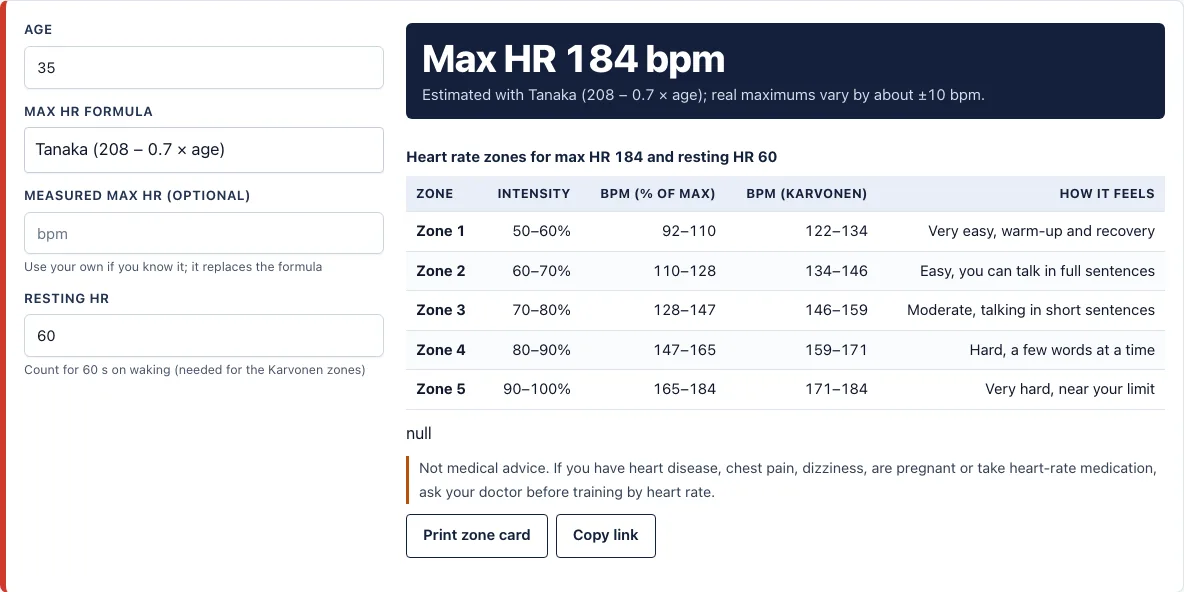
How to use the heart rate zone calculator
- Enter your age.
- Choose a max HR formula: Tanaka (208 - 0.7 x age), 220 - age, or Gulati for women (206 - 0.88 x age).
- If you have a measured max HR from a hard test, type it into the measured max field. It replaces the formula.
- Enter your resting heart rate in bpm.
- Read the output: your estimated or measured max HR, then the zone table.
- Check the “how it feels” column to match each zone to your effort.
Before you start, decide whether you want an estimated or a measured max HR. A formula works when you have no recent hard effort to measure from. A measured max works better, because the zones are then built from your own top heart rate. Whichever you use, keep a note of it, so you know which number a zone table was based on. The Karvonen figures appear only when a resting heart rate is entered, so enter one if you want to compare the two methods.
The Print zone card button prints just the table, so you can keep it with your training log. The Copy link button shares or bookmarks the exact result, because your settings are kept in the page address. On small screens, the table scrolls sideways inside its box. The page also works on a phone, so you can check your zones before a run.
What are the 5 heart rate zones?
The five heart rate zones are bands of your maximum heart rate: 50-60%, 60-70%, 70-80%, 80-90% and 90-100%. Each band matches a different training effort, from very easy recovery to all-out bursts. The lower zones build endurance, and the higher zones build speed and the ability to hold a hard pace.
The “how it feels” column describes each zone in plain terms. Zone 1 is very easy. Zone 2 is easy, and you can speak in full sentences. Zone 3 is moderate, and you can manage only short sentences. Zone 4 is hard, and you can say only a few words at a time. Zone 5 is very hard and cannot be sustained for long.
How do I calculate my heart rate zones?
Start with your max heart rate. Use a measured value if you have one; otherwise use one of the formulas, based on your age. Then multiply max HR by each zone’s percentage to get the bpm range.
For a 35-year-old using the Tanaka formula, max HR is 208 - (0.7 x 35) = 183.5 bpm, shown rounded as 184. Zone 2 (60-70%) is 110-128 bpm, and zone 4 (80-90%) is 147-165 bpm.
The Karvonen formula (Karvonen, 1957) uses heart rate reserve, which is the gap between max HR and resting HR. Target = resting HR + intensity x (max HR - resting HR). With a resting HR of 60, the reserve is 123.5 bpm. Zone 2 by Karvonen is 60 + 0.6 x 123.5 to 60 + 0.7 x 123.5, which gives 134-146 bpm. Zone 4 is 159-171 bpm.
Karvonen zones are higher than percent-of-max zones at the same percentage because they start from resting heart rate. Formula estimates of max HR are often off by about 10 bpm or more, so a measured maximum is more accurate when you can get one.
What is the Karvonen formula?
The Karvonen formula (Karvonen, 1957) sets a target heart rate from heart rate reserve. Reserve is the gap between your max HR and your resting HR. The target is resting HR + intensity x (max HR - resting HR), where intensity is the zone percentage written as a decimal. Because the calculation starts from resting heart rate, the same percentage gives a different target than a percent-of-max calculation does.
The calculator shows both methods when you enter a resting heart rate, so you can compare them side by side. The max HR used is the same in both. The only difference is the starting point and the reserve that the percentage is applied to.
How accurate is a max heart rate formula?
Formula estimates of max HR are often off by about 10 bpm or more, so treat them as a starting point rather than a measurement. The tool offers three choices: Tanaka, 220 - age, and Gulati for women. The formulas give different estimates at most ages, so the choice changes the bpm edge of every zone.
If you have a measured max from a hard test, enter it in the measured max field. The formula is then no longer used. Each zone is a percentage of max HR, so an error in the max figure moves the bpm edge of every zone.
Frequently asked questions
Which zone should I train in?
Most easy running falls in zones 1 and 2, where you can still hold a conversation. Harder work in zones 4 and 5 is best kept short and spaced out, with easy days between. Your goal and your training plan decide the right mix.
How do I measure resting heart rate?
Count your pulse for 60 seconds after waking, before you get up. Use your wrist or neck and a clock or watch. Repeat it on several mornings and use the typical number, because a single reading can be unusual.
Why are my Karvonen zones higher than my percent-of-max zones?
The Karvonen method starts from your resting heart rate and applies the percentage to the gap between resting and max. The same percentage therefore gives a higher bpm target. Pick one method and use it consistently across a training block.
Does the calculator store what I enter?
No. The tool runs entirely in your browser, so nothing you type is uploaded or stored on a server. No account is needed. Your settings are kept in the page address, so a copied link carries your inputs with it.
Is it safe to train by heart rate if I have a health condition?
Not without checking first. People with heart disease, chest pain, dizziness, pregnancy, or medication that affects heart rate should ask a doctor before training by heart rate. Stop exercising and seek help if you feel chest pain or dizziness.
Can I print or share my zones?
Yes. Print zone card prints just the table, so you can keep it with your training log. Copy link shares or bookmarks the exact result, because your settings are kept in the page address.
Does the calculator work on a phone?
Yes. The page works on phones. On small screens the zone table scrolls sideways inside its box, so you can read every zone without leaving the page.
Related tools
- Max heart rate calculator: use it to compare formula estimates of max HR before you enter one here.
- Zone 2 heart rate calculator: use it when you want only your zone 2 target range.
- Training pace calculator: use it to turn your training effort into target paces.
- VO2 max calculator: use it to estimate your aerobic fitness level.
- Marathon training plan: use it to see how zones fit into a full marathon schedule.
- Running cadence calculator: use it to check your steps per minute alongside your heart rate.
- Methodology: formulas and plan rules: read it to see the formulas and rules behind these calculators.