
Marathon Training Plan Generator
Pick your weeks, running days, level and goal time to get a full marathon plan with every run and pace.
Recent
Your last 10 settings, saved only in this browser. Nothing is uploaded.
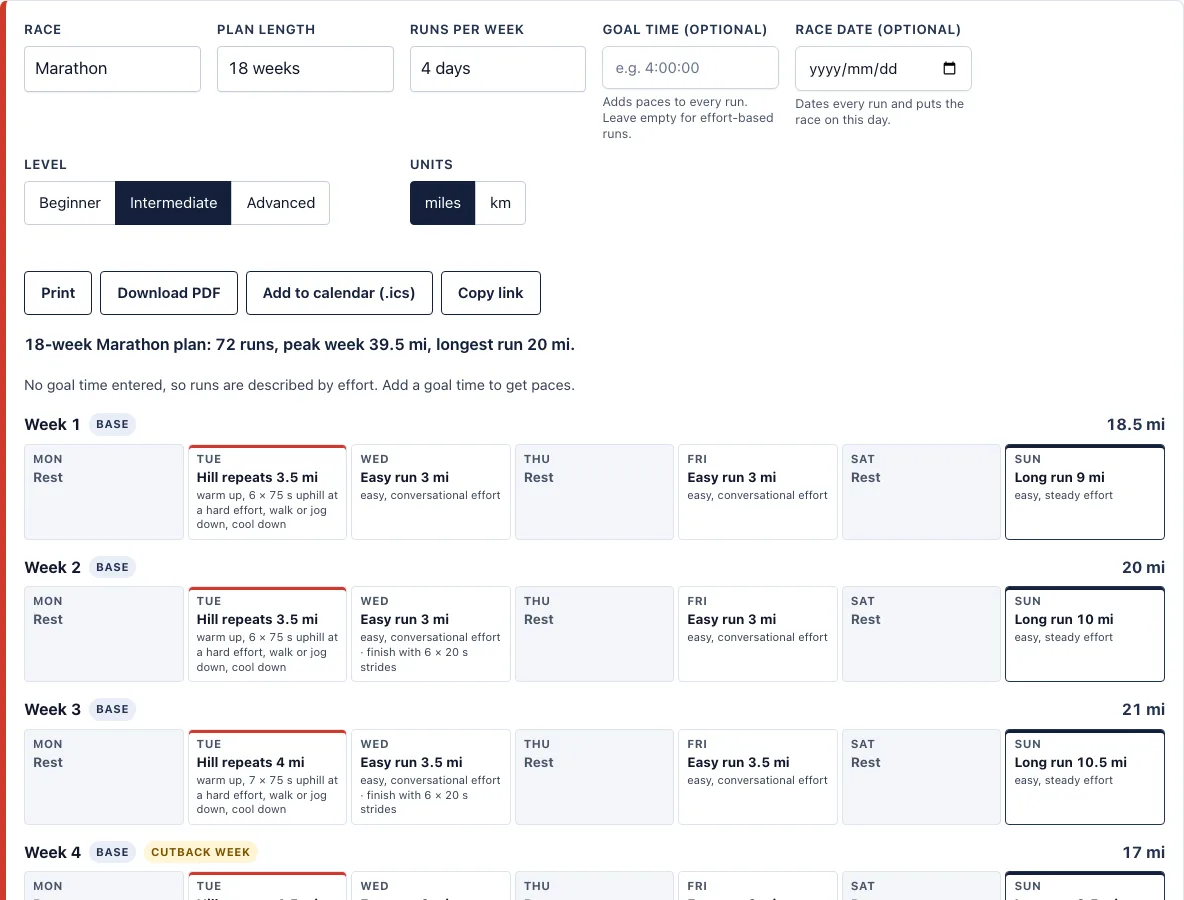
How to use the Marathon Training Plan Tool
- Set Race to marathon. The tool also offers 5K, 10K, half marathon and 50K.
- Set Plan length between 12 and 24 weeks.
- Set Runs per week to 3, 4, 5 or 6 days.
- Choose a Level: Beginner, Intermediate or Advanced.
- Optional: enter a Goal time to get a box of training paces and a pace range for every run.
- Optional: enter a Race date. Week 1 then starts on a Monday and the race falls on the final day. Without a race date, long runs fall on Sunday.
- Choose Units, miles or km.
- Read the summary line first (weeks, runs, peak week distance and longest run), then the paces, then the weekly boxes.
The Copy link button shares or bookmarks the exact plan, because your settings are kept in the page address. The Print button prints only the plan, not the rest of the page. Download PDF saves a text PDF of the whole plan, made in your browser. The Add to calendar (.ics) button creates one all-day event per run for Google Calendar, Apple Calendar or Outlook. Without a race date, the plan starts the next Monday. The miles/km switch changes every pace and distance, and your choice is remembered in this browser. Changing a setting rebuilds the whole plan, so moving from 4 to 5 runs a week changes the distance of every week.
How long should a marathon training plan be?
A marathon plan can run from 12 to 24 weeks. The default here is 18 weeks, and 24 weeks is about six months. A longer plan gives more time to build up gradually, which is the main reason to choose it.
The plan is divided into phases. The base phase covers the first 40% of the build and uses easy runs, strides and hill repeats. The build phase covers the next 40% and adds tempo runs and intervals. The race-specific phase takes the last 20%, with race-pace runs. Intermediate and advanced marathon plans also end the long run with a race-pace segment.
How many miles a week should I run for a marathon?
There is no single target. The peak week depends on your level, plan length and runs per week. One firm rule is that no week is more than 10% above the largest earlier week. Every 4th week is a cutback week at about 80% of the week before, so your body gets a lighter week.
For example, the 18-week intermediate plan with 4 runs a week peaks at 39.5 miles (64 km). A 16-week beginner plan with 4 runs a week peaks at 31 miles (50 km).
How long should my longest run be before a marathon?
For beginner and intermediate plans, the marathon long run tops out at 32 km (about 20 miles). For advanced plans, it tops out at 35 km (about 22 miles). The long run is also capped as a share of the week: up to 50% of weekly distance on 3 or 4 running days, 45% on 5 days and 40% on 6 days.
In the beginner example above, the longest run is 15.5 miles (25 km). In the intermediate example, it is 20 miles (32 km).
Can a beginner train for a marathon?
Yes. Choose Beginner and 3 or 4 runs a week. Beginner plans start with fewer hard sessions, and none in the base phase. Hard sessions such as hills, tempo, intervals and race pace are never scheduled the day before or after the long run. Easy runs are at least 3 km.
A 16-week beginner plan at 4 runs a week with a 4:30:00 goal gives 64 runs. Its easy pace is 11:51 to 13:23 per mile.
Can I print the plan or get it as a PDF?
Yes. The Print button prints only the plan, not the rest of the page. The Download PDF button makes a text PDF of the whole plan in your browser. Because it is made in your browser, the file is created on your device.
What is a taper?
A taper is the reduction in training before a race, so your legs recover and you arrive fresh. A marathon plan tapers for three weeks. The first taper week is about 80% of the peak week, the second is about 65%, and the final week is race week.
What does the summary line show?
The summary line sits above the weeks and gives the number of weeks and runs, the peak week distance and the longest run. Check it first, since it shows whether the plan matches the length and volume you expect.
Frequently asked questions
Do I need a goal time?
No. Without a goal time, each run is described by effort, such as “easy, conversational effort.” With a goal time, each run gets a pace range per mile or km, and a box of training paces appears above the weeks.
Is the tool free, and is my data stored?
Yes, the tool is free and needs no account. It runs in your browser, and nothing you type is uploaded or stored on a server.
Can I save my plan or sync it to reminders?
Not yet. Saving plans, moving missed runs, calendar sync and reminders are coming soon, and everything on the page stays free. You can already use Add to calendar (.ics) to put each run into your calendar app as an event.
Is this medical advice?
No. Build up gradually, and ask a doctor before you start if you have a health condition.
Who wrote the plan?
No coach or book is behind it. The code generates each plan from your inputs, so changing the weeks, days or level changes the whole plan.
How are the training paces worked out?
The paces come from your goal time using the Daniels and Gilbert (1979) equations, with the tool’s own zone definitions. The full formulas and plan rules are on the methodology page.
Can I use the plan commercially, for example with runners I coach?
Yes. Plans, PDFs and calendar files you make here are free to use for any purpose, including handing them to runners you coach, with no credit needed. You may not copy the generator or the site itself; see the terms.
Related tools
- Half marathon training plan: Use it if you are training for 21.1 km instead of a full marathon.
- 5K training plan: Use it for a shorter race with a plan of 6 to 12 weeks.
- 10K training plan: Use it for an 8 to 14 week plan aimed at 10 km.
- Beginner running plan: Use it if you are new to running and want a gentler starting point.
- 16 week marathon training plan: Use it if you want a marathon plan with a fixed 16-week length.
- Training pace calculator: Use it to get training paces from a recent race result.
- Boston qualifying times: Use this to check the 2027 Boston Marathon standard for your age group.
- Running cadence calculator: Use this to check your steps per minute and set a cadence target.
- Pace chart for this race: Use it to see split times for your goal race pace.
- Pace band: Use it to carry your race pace on a printed band during the race.
- Methodology: formulas and plan rules: Use it to read the formulas and rules behind every plan.