
Max Heart Rate Calculator
Enter your age to compare the three common maximum heart rate formulas.
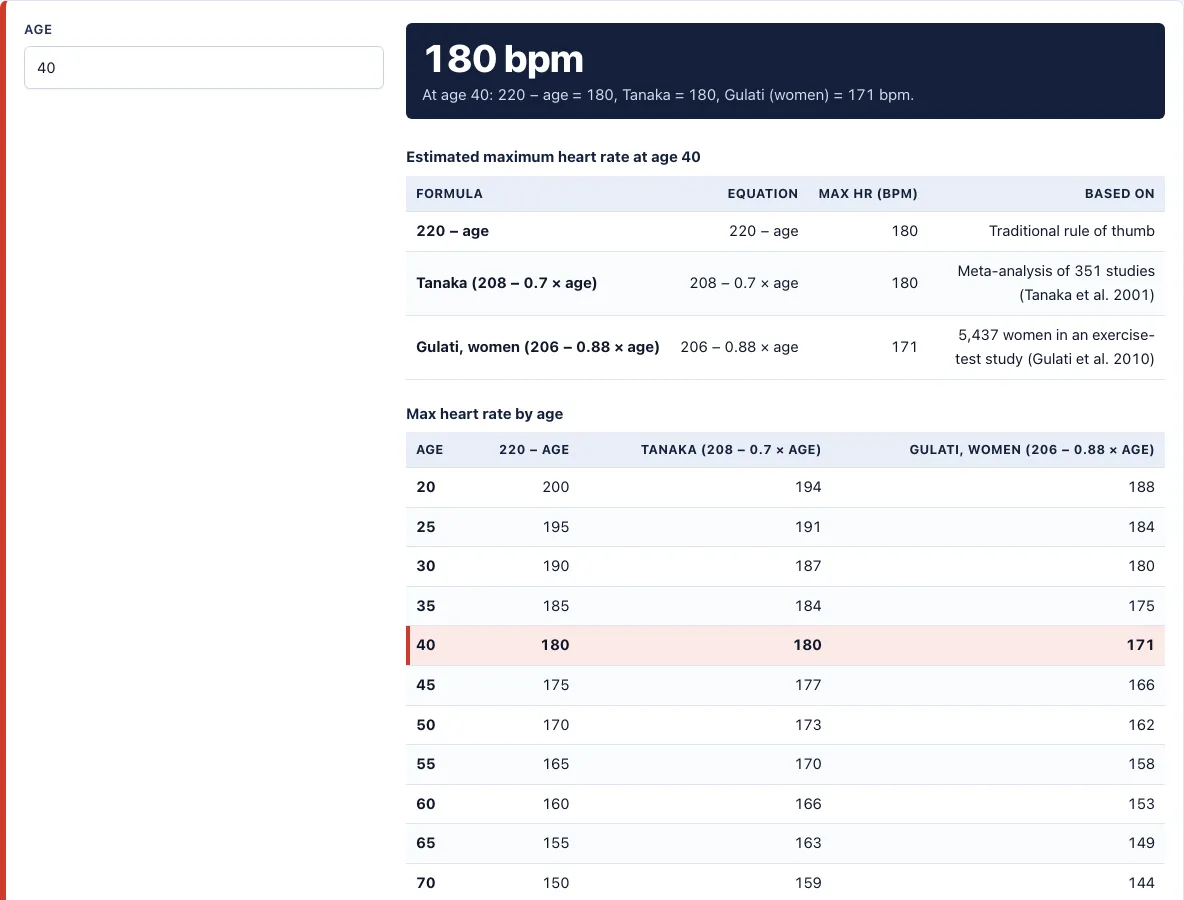
| Age | 220 − age | Tanaka (208 − 0.7 × age) | Gulati, women (206 − 0.88 × age) |
|---|---|---|---|
| 20 | 200 | 194 | 188 |
| 25 | 195 | 191 | 184 |
| 30 | 190 | 187 | 180 |
| 35 | 185 | 184 | 175 |
| 40 | 180 | 180 | 171 |
| 45 | 175 | 177 | 166 |
| 50 | 170 | 173 | 162 |
| 55 | 165 | 170 | 158 |
| 60 | 160 | 166 | 153 |
| 65 | 155 | 163 | 149 |
| 70 | 150 | 159 | 144 |
| 75 | 145 | 156 | 140 |
| 80 | 140 | 152 | 136 |
Recent
Your last 10 settings, saved only in this browser. Nothing is uploaded.
This max heart rate calculator estimates your maximum heart rate from your age using three published formulas. Enter your age and the tool shows each estimate side by side, with the equation behind it and what it is based on. It runs entirely in your browser, so nothing you type is uploaded or stored on a server. It is free, and no account or sign-up is needed.
Your maximum heart rate is the highest number of beats per minute your heart can reach during all-out effort. Age is the main factor behind that number, which is why all three formulas use it. A formula gives an average for people your age, not a reading of your own heart, so treat the result as a starting point. A chart shows how the three estimates change from age 20 to 80, which makes the differences between them easy to compare.
How to use the Max Heart Rate Calculator
- Type your age into the age box. The tool accepts ages from 10 to 100.
- Read the three estimates side by side. Each one shows its equation and what it is based on.
- Check the answer box. It shows the Tanaka value as the headline result.
- Look at the chart below it: all three estimates for every fifth year of age from 20 to 80, with the row nearest your age highlighted.
- Click Copy link to copy the address that holds your result.
Your settings are stored in the page address, so you can bookmark the page or share the link to open the exact same result later. The page works on phones. If a table is too wide for the screen, it scrolls sideways inside its own box.
The page has one input, your age, so there is nothing else to set. Read the three estimates as a range rather than a single answer. If they are close together at your age, the formula choice matters less. If they are far apart, the estimate is less certain, and a measured maximum from a supervised test is the better guide.
Each estimate shows what it is based on, so you can check where a value comes from before you rely on it. To compare ages, change the age box and read the answer box again, then return to the chart for the full range.
How do I calculate my max heart rate?
You can estimate your maximum heart rate with a short formula that uses only your age. Each formula multiplies your age by a number, then subtracts that product from a starting value.
For the Tanaka formula, multiply your age by 0.7 and subtract the result from 208. At age 40, that is 0.7 × 40 = 28, and 208 − 28 = 180 beats per minute. For the Gulati formula, multiply your age by 0.88 and subtract the result from 206. At age 40, that is 206 − 35.2 = 170.8, or about 171.
Is 220 minus age accurate?
220 minus age is a traditional rule of thumb. It is easy to remember, but it is an average. At age 40 it gives the same value as Tanaka (180); Gulati is lower, at 171.
The gap grows at other ages. At age 30, 220 minus age gives 190, while Tanaka gives 187. At age 60, it gives 160, while Tanaka gives 166. So 220 minus age runs higher than Tanaka below age 40 and lower above age 40.
What is the Tanaka formula?
The Tanaka formula is 208 − 0.7 × age. Tanaka, Monahan and Seals published it in 2001 in the Journal of the American College of Cardiology. It was based on a meta-analysis of 351 studies.
The answer box shows the Tanaka value as the headline result. The other two estimates stay visible, so you can see how much they differ.
Is max heart rate different for women?
The Gulati formula is the one of the three based on data from women. Gulati et al. published 206 − 0.88 × age in Circulation in 2010, based on 5,437 women. At age 60, it gives 153, compared with 166 from Tanaka.
This difference comes from the formula’s source data, not from a measurement of your heart.
How can I measure my real max heart rate?
A real maximum is measured during a hard, all-out effort or in a supervised exercise test. Only healthy people should attempt this, and a test supervised by a doctor is the safest option. A formula is not a substitute for a measured result.
If you are healthy and decide to try an all-out effort on your own, warm up thoroughly first and stop immediately if you feel chest pain, dizziness or unusual breathlessness.
Does max heart rate drop with age?
Yes. All three formulas show your estimated maximum falling as you get older. The drop is steady in each formula: 220 minus age falls by 1 beat per minute each year, Tanaka by 0.7 per year, and Gulati by 0.88 per year.
Between age 30 and age 60, the Tanaka estimate drops from 187 to 166, a fall of 21 beats per minute. Your own maximum may follow a different path, so the formulas describe the average trend rather than a fixed rule for you.
What is max heart rate used for?
Max heart rate sets the top of your heart rate zones, because each zone is a percentage of it. The heart rate zone calculator builds the full set of five zones from a max value, so it is the next step once you have chosen an estimate.
How this tool works and where the numbers come from
Maximum heart rate is estimated from age with three published formulas: 220 minus age, Tanaka (208 - 0.7 x age) and Gulati (206 - 0.88 x age, from women). Individual maximums scatter by about 10 beats per minute or more around any formula, so a measured maximum is better.
Sources
Frequently asked questions
Which estimate should I trust?
No single estimate is right for everyone. The Tanaka value is the headline result, and the other two show how much the estimates can differ at your age. If the three values are close, the choice matters less for your zones. If they are far apart, a measured value is the better guide.
Can my real max heart rate be higher or lower than the estimate?
Yes. Individual maximum heart rates can differ from any formula by about 10 beats per minute or more. A formula gives an average for your age group, not a reading of your own heart.
Do I need a doctor before training by heart rate?
Yes, you should ask a doctor first if you have heart disease, chest pain or dizziness, if you are pregnant, or if you take medication that affects your heart rate. This tool does not give medical advice. Stop exercising and seek help if you feel chest pain or dizziness.
Does the tool store the age I enter?
No. The tool runs entirely in your browser. Nothing you type is uploaded or stored on a server, and no account or sign-up is needed.
Can a formula replace a supervised exercise test?
No. A formula gives an estimate, while a supervised exercise test measures your maximum. If you want a measured value, a doctor-supervised test is the safest way to get one.
Can I see estimates for other ages?
Yes. The chart shows all three estimates for every fifth year of age from 20 to 80, so you can see how the values change over time. Change the age box to read the estimates for one age in detail.
Does the page work on a phone?
Yes. The page works on phones. On small screens, any wide table scrolls sideways inside its own box.
Related tools
- Heart rate zone calculator: Use it to turn your max heart rate into training zones.
- Zone 2 heart rate calculator: Use it to find the heart rate range for easy, steady training.
- VO2 max calculator: Use it to estimate your aerobic fitness from your training data.
- Training pace calculator: Use it to set paces for different types of runs.
- Running cadence calculator: Use it to work out your steps per minute while running.
- Beginner running plan: Use it if you are starting to run and want a week-by-week schedule.
- Methodology: formulas and plan rules: Use it to read how the formulas and plan rules on this site work.