
mph to Minutes per Mile Converter
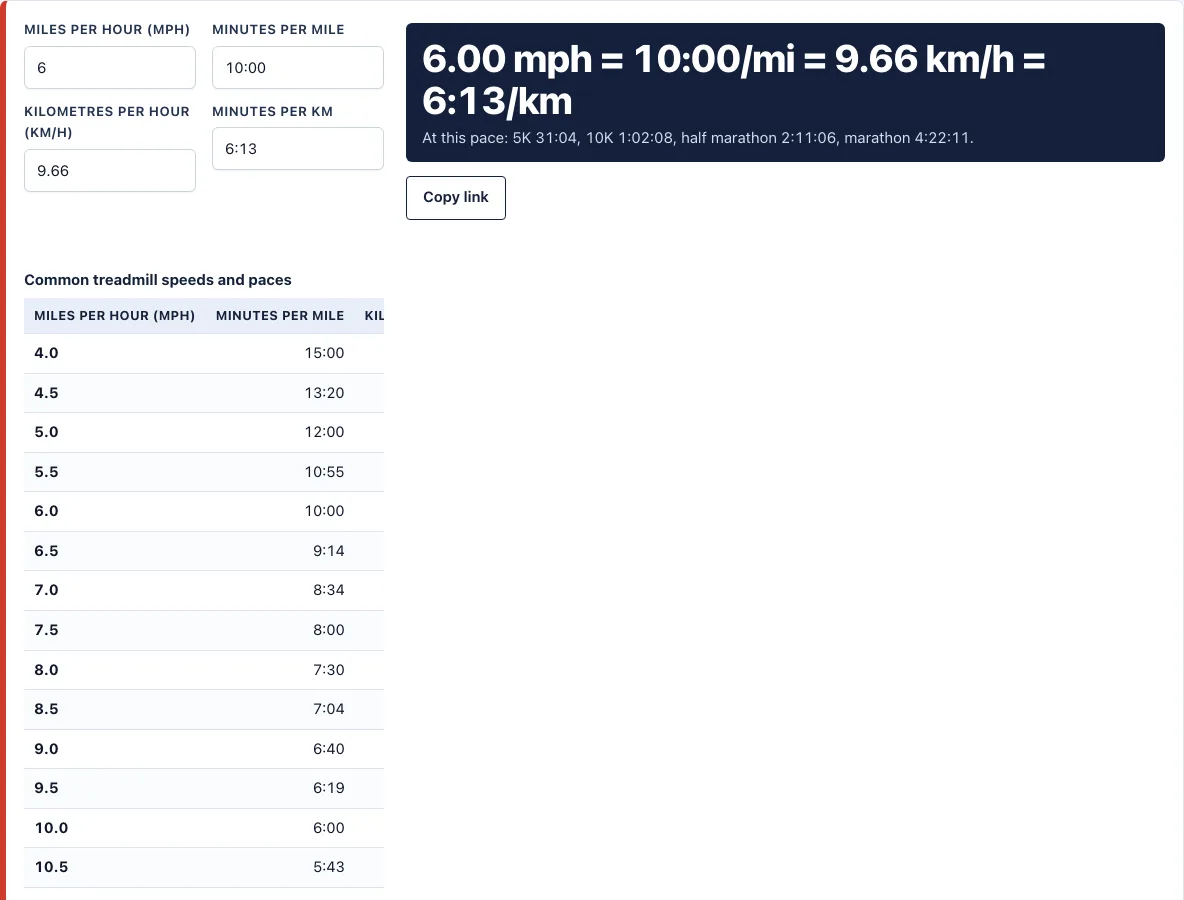
Type a speed or a pace in any box: mph, minutes per mile, km/h or minutes per km.
| Miles per hour (mph) | Minutes per mile | Kilometres per hour (km/h) | Minutes per km |
|---|---|---|---|
| 4.0 | 15:00 | 6.4 | 9:19 |
| 4.5 | 13:20 | 7.2 | 8:17 |
| 5.0 | 12:00 | 8.0 | 7:27 |
| 5.5 | 10:55 | 8.9 | 6:47 |
| 6.0 | 10:00 | 9.7 | 6:13 |
| 6.5 | 9:14 | 10.5 | 5:44 |
| 7.0 | 8:34 | 11.3 | 5:20 |
| 7.5 | 8:00 | 12.1 | 4:58 |
| 8.0 | 7:30 | 12.9 | 4:40 |
| 8.5 | 7:04 | 13.7 | 4:23 |
| 9.0 | 6:40 | 14.5 | 4:09 |
| 9.5 | 6:19 | 15.3 | 3:55 |
| 10.0 | 6:00 | 16.1 | 3:44 |
| 10.5 | 5:43 | 16.9 | 3:33 |
| 11.0 | 5:27 | 17.7 | 3:23 |
| 12.0 | 5:00 | 19.3 | 3:06 |
Recent
Your last 10 settings, saved only in this browser. Nothing is uploaded.
How to use the mph to minutes per mile converter
- Find the four boxes: miles per hour (mph), minutes per mile, kilometres per hour (km/h) and minutes per km.
- Type your known value into any one of the boxes. For a treadmill, type the mph shown on the display.
- Read the other three boxes. They fill in automatically with the matching speed or pace.
- Check the finish times under the answer to see how long a 5K, 10K, half marathon and marathon take at that pace.
- Scroll to the treadmill table for common speeds from 4 to 12 mph, with pace per mile, km/h and pace per km.
- Press Copy link to save or share the exact result you are looking at.
Your settings are kept in the page address, so the link opens with the same numbers. On a phone, the treadmill table scrolls sideways inside its box, so swipe across it to see the faster speeds.
The four boxes are linked, so you can start from whichever value you already know. A treadmill speed in mph and a race pace in minutes per km both work as the starting value, and the other boxes update to match. The finish times under the answer use the pace you entered, which helps when you are choosing a race pace to hold. The treadmill table is a fixed list of speeds, so you can find a row and read its pace without typing anything.
How do you convert mph to minutes per mile?
Divide 60 by your speed in miles per hour. The result is the number of minutes it takes to cover one mile at that speed.
For example, at 7 mph, 60 ÷ 7 = 8.571. The whole number 8 is the minutes. The 0.571 is a fraction of a minute, so multiply it by 60 to get seconds: 0.571 × 60 ≈ 34. The pace is 8:34 per mile.
The same division works for any speed, including the treadmill speeds in the table below. Faster speeds give smaller pace numbers, because you spend less time on each mile. Some quick checks: 5 mph gives 60 ÷ 5 = 12, so 12:00 per mile, and 10 mph gives 6:00 per mile. If you need km/h instead, multiply mph by 1.609344, since one mile is 1.609344 km. At 7 mph, that is about 11.27 km/h.
How do you convert minutes per mile to mph?
Divide 60 by your pace in minutes per mile. If the pace includes seconds, convert the seconds to a decimal part of a minute first.
For a pace of 9:00 per mile, the time is already 9 whole minutes, so 60 ÷ 9 = 6.67 mph. For 8:30 per mile, write the pace as 8.5 minutes, then 60 ÷ 8.5 = 7.06 mph.
This works in both directions. A pace of 9:00 per mile equals 6.67 mph, which is the same as 5:36 per km. When you check your answer, a bigger pace number should always give a smaller mph, so the two values move in opposite directions.
How do you convert min per km to min per mile?
Multiply the pace per km in minutes by 1.609344, because one mile is 1.609344 km. For 5:00 per km, the result is about 8:03 per mile. To go the other way, divide the pace per mile by 1.609344 to get the pace per km.
What finish time does a 6 mph pace give?
At 6 mph, which is 10:00 per mile, a 5K takes 31:04 and a 10K takes 1:02:08. The same pace gives 2:11:06 for a half marathon and 4:22:11 for a marathon. These times assume you hold that pace for the whole distance, so they are estimates for steady running.
Common running speeds in minutes per mile (5 to 12 mph)
Pace per mile is 60 divided by the speed in mph, then written as minutes and seconds. These are the speeds most runners set on a treadmill, rounded to the nearest second:
| Speed | Pace per mile |
|---|---|
| 5 mph | 12:00 |
| 6 mph | 10:00 |
| 6.5 mph | 9:14 |
| 7 mph | 8:34 |
| 7.1 mph | 8:27 |
| 7.5 mph | 8:00 |
| 8 mph | 7:30 |
| 9 mph | 6:40 |
| 10 mph | 6:00 |
| 11 mph | 5:27 |
| 12 mph | 5:00 |
For a speed that is not in the list, type it into the mph box above.
Frequently asked questions
What pace is 7 mph?
7 mph is 8:34 per mile, which is about 5:20 per km. It is also about 11.27 km/h.
Why does 7 mph show 8:34 and not 8:30?
Because 60 ÷ 7 is 8.571 minutes, and 0.571 of a minute is about 34 seconds, not 30. Paces are usually written to the nearest second.
What is 1 mile in kilometres?
One mile is exactly 1.609344 km. The converter uses this figure for every conversion between mph, km/h, minutes per mile and minutes per km.
What pace is 10 mph?
10 mph is 6:00 per mile. The same rule works in reverse, so a pace of 6:00 per mile is 10 mph.
What pace is 7.5 mph?
7.5 mph is 8:00 per mile. Divide 60 by any speed in mph to get its pace per mile.
Does the treadmill table show km/h?
Yes. The table lists speeds from 4 to 12 mph, with pace per mile, km/h and pace per km for each one. On a phone, swipe the table sideways to see the pace per km column.
Does the converter store the numbers I enter?
No. The tool runs in your browser, and nothing you type is uploaded or stored on a server. It is free, and no account is needed.
Can I type a pace and get the mph?
Yes. Type a pace in minutes per mile, and the mph box fills in with the matching speed. A pace of 9:00 per mile, for example, gives 6.67 mph.
Related tools
- Treadmill pace chart: use it when you want to scan a full list of treadmill speeds and their paces at once.
- Treadmill incline calculator: use it when you train on an incline and want to adjust your effort.
- Pace calculator: use it when you want to work out a pace for a planned run.
- Race pace calculator: use it when you have a race distance and a target finish time and need the pace to hit it.
- Marathon pace chart: use it when you are planning marathon training and want paces for different finish times.
- 10K pace chart: use it when you are aiming for a 10K and want paces to train at.