
How Do I Calculate Marathon Pace From My 5K Time?
A 25:00 5K predicts a marathon near 3:58, or 9:04 per mile. Enter your own 5K.
Free · runs in your browser · nothing is uploaded
Recent
Your last 10 settings, saved only in this browser. Nothing is uploaded.
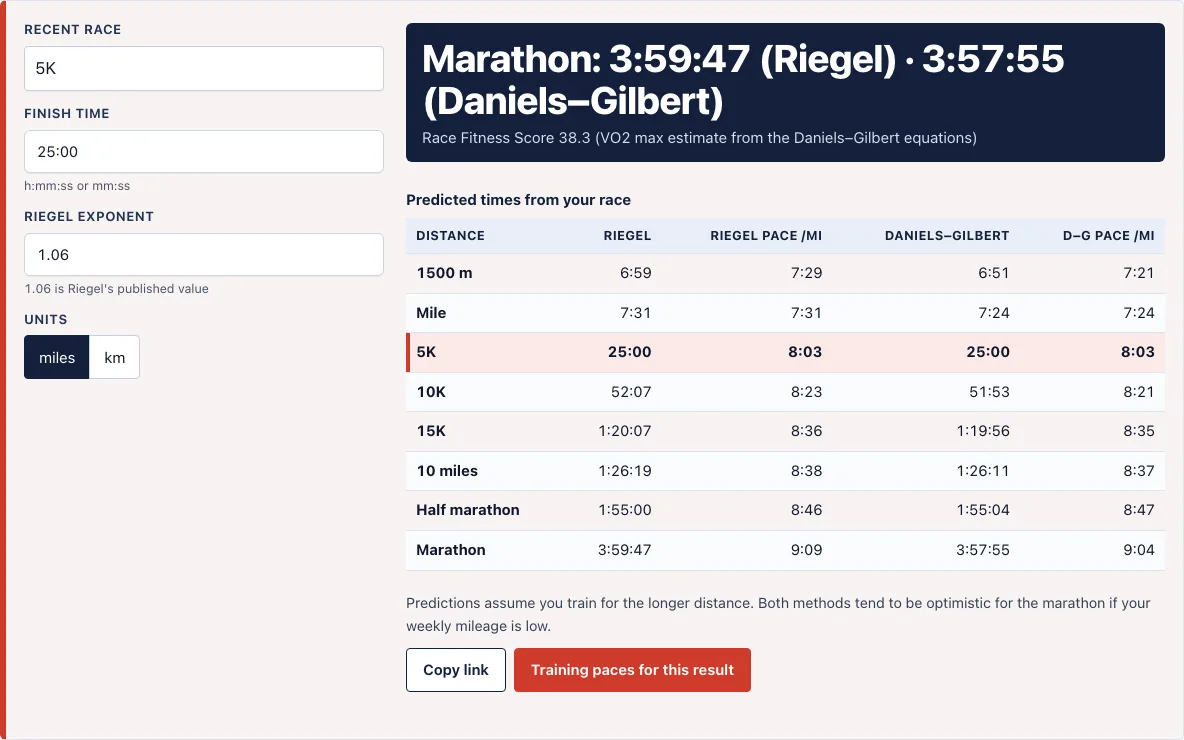
Marathon pace from 5K: a 25:00 5K predicts a marathon of about 3:57:55 by the Daniels and Gilbert equations, which is 9:04 per mile or 5:38 per km. Riegel’s formula gives 3:59:47. The predictor below is set to a 5K in 25:00; enter your own time to see both estimates, along with the 10K, half marathon and shorter distances.
Treat the marathon figure as a ceiling. A 5K time shows speed; the marathon also needs weekly mileage and long runs. Below the tool you will find the 5K time needed for a 3:00, 3:30, 4:00 or 5:00 marathon.
Everything is calculated in your browser, so nothing you type is uploaded, and the tool is free with no account or sign-up.
Want this on your phone? Get the RunPacePlan app for Android; the iPhone version is coming soon.
How to use the predictor
- Recent race is set to 5K. Change it if your best recent result is another distance.
- Enter your Finish time as mm:ss or h:mm:ss.
- Leave the Riegel exponent at 1.06 unless you have a reason to change it.
- Choose miles or km with the Units switch.
- Read the marathon line at the top, then the table of times and paces from 1500 m to the marathon. Riegel and Daniels–Gilbert sit side by side, each with a pace per mile or km.
- The Race Fitness Score under the headline is an estimate of VO2 max from the same equations. Copy link keeps your result, and the predictor works the same on a phone.
The calculation runs in your browser and nothing you type is uploaded. Prefer your phone? There is a RunPacePlan app for Android, with the iPhone version coming soon.
Two tips for a good result. First, use a recent race or a hard, even effort, not a best from years ago. Second, read both columns: when Riegel and Daniels and Gilbert disagree, Riegel is the slower figure and the safer plan for a first marathon. Run the predictor again after your next race, because the numbers move as you get fitter.
How do I calculate my marathon pace from my 5K time?
Predict the marathon time first, then divide by 26.2 miles. For a 25:00 5K the Daniels and Gilbert estimate is 3:57:55, or 9:04 per mile (5:38 per km). Riegel’s formula T2 = T1 x (D2 / D1)^1.06 gives 3:59:47. The same 5K predicts a half marathon of about 1:55:04 and a 10K of 51:53. The table gives the marathon prediction for other 5K times.
| 5K time | Marathon (Daniels–Gilbert) | Pace per mile | Pace per km | Marathon (Riegel) |
|---|---|---|---|---|
| 16:00 | 2:33:26 | 5:51 | 3:38 | 2:33:27 |
| 18:00 | 2:52:25 | 6:35 | 4:05 | 2:52:38 |
| 20:00 | 3:11:17 | 7:18 | 4:32 | 3:11:49 |
| 22:00 | 3:30:03 | 8:01 | 4:59 | 3:31:00 |
| 24:00 | 3:48:40 | 8:43 | 5:25 | 3:50:11 |
| 26:00 | 4:07:08 | 9:26 | 5:51 | 4:09:22 |
| 28:00 | 4:25:28 | 10:08 | 6:17 | 4:28:33 |
| 30:00 | 4:43:39 | 10:49 | 6:43 | 4:47:44 |
| 32:00 | 5:01:42 | 11:30 | 7:09 | 5:06:55 |
| 34:00 | 5:19:36 | 12:11 | 7:34 | 5:26:06 |
| 36:00 | 5:37:22 | 12:52 | 8:00 | 5:45:17 |
| 38:00 | 5:55:01 | 13:32 | 8:25 | 6:04:28 |
| 40:00 | 6:12:33 | 14:13 | 8:50 | 6:23:39 |
What 5K time do I need for a 3:00, 3:30, 4:00 or 5:00 marathon?
By the Daniels and Gilbert estimate, a 3:00 marathon matches a 5K of about 18:48, a 3:30 marathon about 22:00, a 4:00 marathon about 25:14 and a 5:00 marathon about 31:49. Having that 5K does not mean you will run that marathon; it means your speed is there.
How accurate is a marathon prediction from a 5K?
Roughly right for a runner with matching mileage, optimistic for one without. Riegel was fitted to records between about 1,500 m and the half marathon, and the marathon often comes out slower than it predicts, especially with low weekly mileage. Check the prediction with a recent half marathon or a long run at the predicted pace.
Why does my marathon prediction look too fast?
Because a 5K is mostly speed and a marathon is mostly endurance. If you run under 25 miles a week the real marathon is usually slower, and Riegel gives the slower, more cautious figure of the two in every row of the table. The marathon training plan builds the mileage the prediction assumes.
How do I use the prediction in training?
Use the predicted pace as the upper limit for marathon-pace runs, not the starting point. If the figure is 9:04 per mile, try a long run with a few miles at 9:20 and see how it feels before moving closer. Then check it against a half marathon: the same 25:00 5K predicts 1:55:04 for the half, and a race near that time is better evidence for the marathon than the 5K alone.
Who is a 5K prediction for?
It suits a runner who races 5Ks and wants a first marathon target, or someone choosing between goal times. It works best for a runner already doing long runs.
What mistakes do people make with the prediction?
Using it as a promise rather than a ceiling, using a slow 5K from a hilly course, and forgetting that both formulas assume the marathon training is behind the 5K. Riegel gives the slower figure in every row, so when the two columns disagree, plan on Riegel.
How does the marathon prediction compare with the half marathon and 10K?
For a 25:00 5K the Daniels and Gilbert estimates are a 10K of 51:53, a half marathon of 1:55:04 and a marathon of 3:57:55. The longer the race, the more the weekly mileage matters. A recent half marathon is better evidence than the 5K.
How this tool works and where the numbers come from
A marathon time is predicted two ways: Riegel’s formula T2 = T1 x (D2 / D1)^1.06, and a Race Fitness Score built from the Daniels and Gilbert oxygen-cost equations. Riegel is best between about 1,500 m and the half marathon and is often optimistic for the marathon. Both assume you have trained for the longer distance.
Sources
Frequently asked questions
What marathon pace does a 25:00 5K predict?
About 9:04 per mile or 5:38 per km (3:57:55) by Daniels and Gilbert, or 3:59:47 by Riegel.
What is the Riegel formula?
T2 = T1 x (D2 / D1)^1.06, where T1 is your time over distance D1 and T2 the predicted time over D2. Peter Riegel published it in American Scientist in 1981.
What is the difference between Riegel and Daniels–Gilbert here?
Riegel scales your time by distance with an exponent. Daniels and Gilbert convert your time into a Race Fitness Score from oxygen-cost equations and find the time at the new distance with the same score. For the marathon Riegel is the slower of the two in every row: the gap is about 2 minutes at a 25:00 5K, 4 minutes at 30:00 and 11 minutes at 40:00. The table shows both.
Can I use a 10K or half marathon instead of a 5K?
Yes. Change Recent race and enter that time. Predictions from a closer distance are more reliable, so a recent half marathon tells you more about a marathon than a 5K does.
How often should I re-run the predictor?
Whenever you have a new recent race or a hard time trial. A prediction from a race a year ago says little about today.
Does the tool use miles or km?
Either. The Units switch changes every pace and distance on the page, and your choice is remembered in this browser.
Is this medical or coaching advice?
No. The predictions are estimates. Build up gradually and ask a doctor first if you have a health condition.
Take this question with you
The RunPacePlan app puts the plan, the paces and the splits for this question on your phone: get it on Google Play. The iPhone version is coming soon.
Related questions
- What Is My Easy Run Pace Based on My 5K Time?: Another question runners ask.
- How Fast Can I Run a 5K Based on My Mile Time?: Another question runners ask.
- What Pace for a 3:30 Marathon?: Another question runners ask.
- What Is the Average Marathon Time?: Another question runners ask.
- How Many Weeks to Train for a Marathon?: Another question runners ask.
Related tools
- Race time predictor: Predict times at every distance from any race.
- Training pace calculator: Training paces from a recent race.
- Marathon pace chart: Pace and splits for finish times from 2:00 to 7:00.
- Sub 4 hour marathon pace: Splits for a 4:00 goal.
- 5K pace chart: Pace per km and per mile for 5K finish times.