
What Is My Easy Run Pace Based on My 5K Time?
A 25:00 5K gives an easy pace of 10:26 to 11:48 per mile. Enter your own 5K.
Free · runs in your browser · nothing is uploaded
Recent
Your last 10 settings, saved only in this browser. Nothing is uploaded.
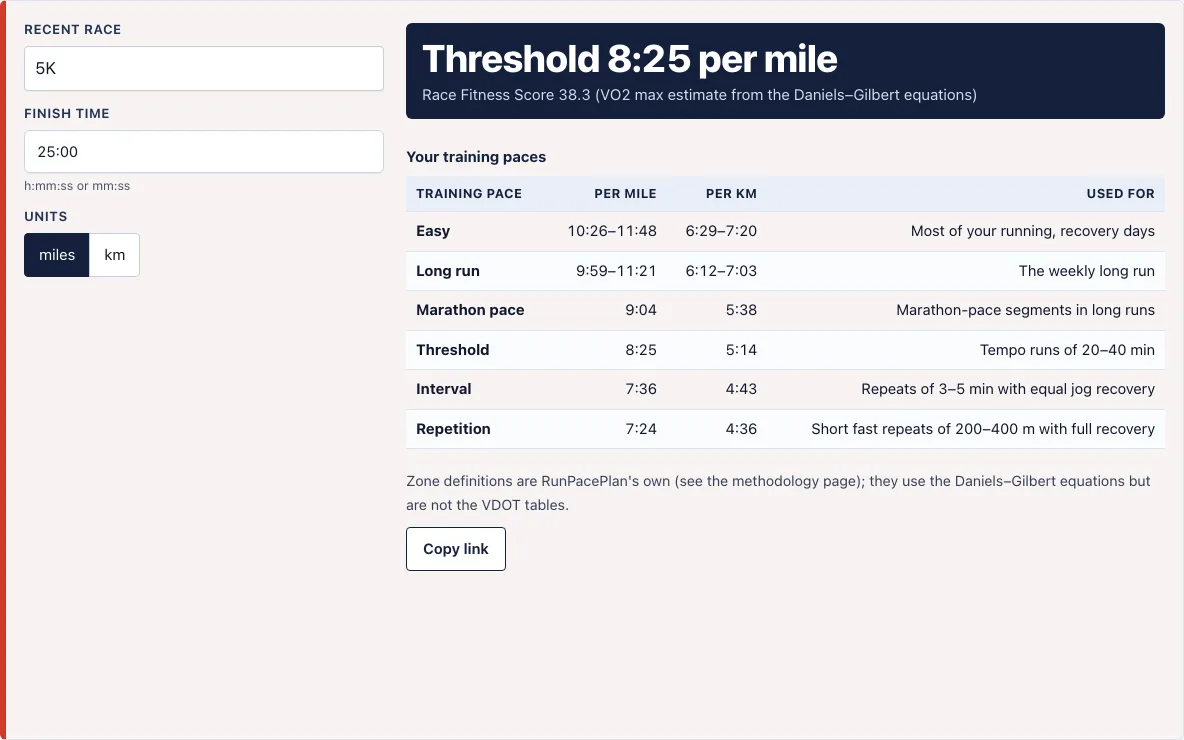
Your easy run pace based on 5K time is the pace you can hold while still talking in full sentences. From a 25:00 5K it is 10:26 to 11:48 per mile, or 6:29 to 7:20 per km. The calculator below is set to a 5K in 25:00; enter your own time to get your range, plus long run, marathon, threshold and interval paces.
Run slowly enough that you finish feeling you could do more; the talk test (speaking comfortably) is a check that tracks the ventilatory threshold in healthy adults. Everything is calculated in your browser, so nothing you type is uploaded, and the tool is free with no account or sign-up.
Want this on your phone? Get the RunPacePlan app for Android; the iPhone version is coming soon.
How to use the calculator
- Recent race is set to 5K. Change it if your best recent result is another distance.
- Enter your Finish time as mm:ss or h:mm:ss.
- Choose miles or km with the Units switch.
- Read the headline pace, then the table of training paces per mile and per km with the use of each.
- Read the Used for column (the right-hand one of the table): it says what each pace is for, from most of your running and recovery days to the weekly long run, marathon-pace segments, tempo runs, intervals and short fast repeats.
- Copy link keeps your result.
The calculation runs in your browser and nothing you type is uploaded. Prefer your phone? There is a RunPacePlan app for Android, with the iPhone version coming soon.
Two tips for a good result. First, use a recent race or a hard, even effort, not a best from years ago. Second, read the whole table, not just the easy line: the long run, threshold and interval paces are part of the same set. Run the calculator again after your next race, because the paces move as you get fitter. The table shows both miles and km whatever Units says.
What is my easy run pace from my 5K time?
For a 25:00 5K the easy pace is 10:26 to 11:48 per mile (6:29 to 7:20 per km). The same result gives a long run pace of 9:59 to 11:21 per mile, marathon-equivalent pace 9:04, threshold 8:25 (5:14 per km), interval 7:36 (4:43 per km) and repetition 7:24 per mile. The table has the easy range for other 5K times.
| 5K time | Easy per mile | Easy per km | Long run per mile | Marathon per mile | Threshold per mile |
|---|---|---|---|---|---|
| 16:00 | 6:44–7:36 | 4:11–4:44 | 6:26–7:19 | 5:51 | 5:31 |
| 18:00 | 7:34–8:33 | 4:42–5:19 | 7:14–8:13 | 6:35 | 6:10 |
| 20:00 | 8:23–9:29 | 5:13–5:54 | 8:02–9:07 | 7:18 | 6:49 |
| 22:00 | 9:13–10:25 | 5:43–6:28 | 8:49–10:01 | 8:01 | 7:28 |
| 24:00 | 10:02–11:20 | 6:14–7:03 | 9:36–10:54 | 8:43 | 8:06 |
| 26:00 | 10:50–12:15 | 6:44–7:37 | 10:22–11:47 | 9:26 | 8:45 |
| 28:00 | 11:39–13:10 | 7:14–8:11 | 11:08–12:39 | 10:08 | 9:23 |
| 30:00 | 12:26–14:04 | 7:44–8:44 | 11:54–13:31 | 10:49 | 10:01 |
| 32:00 | 13:14–14:58 | 8:13–9:18 | 12:39–14:23 | 11:30 | 10:39 |
| 34:00 | 14:01–15:51 | 8:43–9:51 | 13:25–15:14 | 12:11 | 11:17 |
| 36:00 | 14:48–16:44 | 9:12–10:24 | 14:09–16:05 | 12:52 | 11:54 |
| 38:00 | 15:34–17:36 | 9:41–10:56 | 14:54–16:56 | 13:32 | 12:32 |
| 40:00 | 16:20–18:28 | 10:09–11:29 | 15:38–17:46 | 14:13 | 13:09 |
How slow should easy runs be?
Slower than most people expect: here easy is 15 to 30% slower than the pace you could hold for a marathon at the same fitness. You should be able to speak in full sentences and finish feeling you could do more. If your easy pace feels like walking, the range still applies; slow is the point of the run.
Is easy pace the same as zone 2?
They overlap but are not the same. Easy pace comes from a race time; zone 2 comes from heart rate. Heat, hills, sleep and illness move your heart rate without changing the pace you ran last month, so the two can disagree on a given day. The zone 2 heart rate calculator gives a heart-rate range to compare.
Which 5K time should I enter?
Use a recent race or a hard, evenly paced effort. A time from a hilly course or a hot day will make every pace too slow, and a fast downhill 5K will make them too fast. If you have not raced, run 5K flat and steady, then enter that time.
What does easy pace look like at other 5K times?
Easy pace moves a lot with fitness. A 20:00 5K gives an easy range of 8:23 to 9:29 per mile, a 25:00 5K gives 10:26 to 11:48 and a 30:00 5K gives 12:26 to 14:04. The range is wide on purpose: any speed inside it is easy, and the slow end suits hot days, hills and tired legs.
How often should I update my easy pace?
Run the calculator again after each new race or hard time trial, or every month or two of steady training. Your easy pace changes more slowly than your race time, so a faster 5K moves the range by a few seconds a mile, not minutes. After illness or time off, a slower result gives a slower range that is right for now.
Who needs an easy pace?
Anyone following a plan with hard days: easy runs make up most of the week and set up the long run and the sessions that follow. It matters most for runners whose every run drifts to race effort.
What mistakes do people make with easy pace?
Running easy days at marathon-equivalent pace or faster, using an old personal best, and judging the pace by a heart rate monitor on a hot day. If your easy pace feels like walking, the range still applies.
How does easy pace compare with marathon and threshold pace?
For a 25:00 5K the easy pace is 10:26 to 11:48 per mile, marathon-equivalent pace is 9:04 and threshold is 8:25 per mile. So easy runs sit 1:22 to 2:44 per mile slower than marathon pace here. See the training pace calculator for every zone.
How this tool works and where the numbers come from
Training paces come from the Daniels and Gilbert (1979) oxygen-cost equations applied to your race time, with RunPacePlan’s own zone definitions: easy is 15 to 30% slower than the marathon-equivalent pace, the long run 10 to 25% slower. They are estimates.
Sources
Frequently asked questions
What pace is easy for a 25:00 5K?
10:26 to 11:48 per mile, or 6:29 to 7:20 per km.
How slow should my easy runs be?
Slow enough to talk in full sentences. In this tool that is 15 to 30% slower than the marathon-equivalent pace for your fitness.
Why is my easy pace slower than I expected?
Because easy is defined as 15 to 30% slower than the marathon-equivalent pace for your fitness. Slow is the point: easy running builds the base that the harder sessions rest on.
Is easy run pace the same as zone 2?
Not exactly. Easy pace is from a race time and zone 2 is from heart rate; they usually overlap. Compare them with the zone 2 heart rate calculator linked above.
How often should I do easy runs?
Most of your weekly running belongs in the easy range, with one or two harder sessions in a plan. The training plan generators here place hard sessions away from the day before and after the long run.
What are my long run and tempo paces for the same 5K?
For a 25:00 5K the long run is 9:59 to 11:21 per mile and threshold (tempo) is 8:25 per mile. Other 5K times are in the table.
Is this medical or coaching advice?
No. The paces are estimates from a race time. Build up gradually and ask a doctor first if you have a health condition.
Take this question with you
The RunPacePlan app puts the plan, the paces and the splits for this question on your phone: get it on Google Play. The iPhone version is coming soon.
Related questions
- How Do I Calculate Marathon Pace From My 5K Time?: Another question runners ask.
- How Fast Can I Run a 5K Based on My Mile Time?: Another question runners ask.
- What Pace for a 30 Minute 5K?: Another question runners ask.
- How Many Miles a Week to Run a Marathon?: Another question runners ask.
- What Pace Is a Sub 2 Hour Half Marathon?: Another question runners ask.
Related tools
- Training pace calculator: Training paces from any recent race.
- Zone 2 heart rate calculator: A heart-rate range for easy running.
- Race time predictor: Predict other race times from your 5K.
- 5K pace chart: Pace per km and per mile for 5K finish times.
- 5K training plan: A plan with paces for every run.