
Race Time Predictor
Enter a recent race time to predict your time at other distances.
Recent
Your last 10 settings, saved only in this browser. Nothing is uploaded.
How to use the Race Time Predictor
- Choose the distance of your recent race: mile, 3K, 5K, 8K, 10K, 15K, 10 miles, half marathon, marathon, or another distance.
- Enter the finish time for that race.
- Pick miles or km with the unit switch. Every pace and distance updates to match.
- Optionally, change the Riegel exponent. It starts at 1.06, so leave it alone unless you have a specific reason to change it.
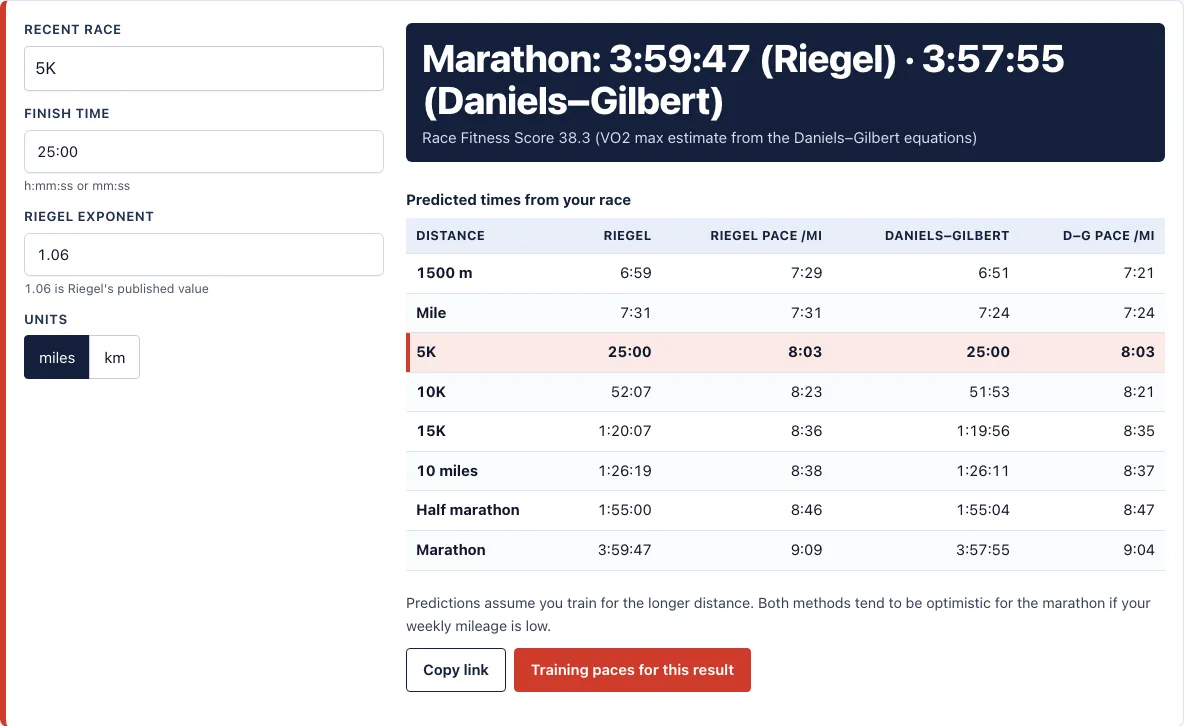
- Read the results table. It lists predicted times and paces for 1500 m, mile, 5K, 10K, 15K, 10 miles, half marathon and marathon, with Riegel and Daniels-Gilbert results side by side.
- Check the Race Fitness Score in the answer box above the table.
- Select “Training paces for this result” to open the training pace calculator with the same race result.
Your settings are stored in the page address, so the “Copy link” button shares or bookmarks the exact result you are looking at. Your unit choice is remembered in this browser. On a phone, wide tables scroll sideways inside their own box.
The results area has one button that matters beyond copying the link: Training paces for this result. It opens the training pace calculator with the same race result, so you do not have to type the time again. When you read the table, look at the Riegel and Daniels-Gilbert columns together, since the two methods can give different answers from the same input.
How accurate are race time predictors?
Race time predictors are useful when the race you enter is recent and your training is focused on the distance you are predicting. They are estimates, not guarantees, because they cannot account for your heat tolerance, course profile, or how well you race on the day.
Both methods assume you have trained equally for the longer distance. For a marathon, both tend to be optimistic when weekly mileage is low, so a fast prediction needs a training base to match it.
What is the Riegel formula?
The Riegel formula was published by Peter Riegel in 1981 in American Scientist. It is written as T2 = T1 × (D2/D1)^1.06, where T1 is your known time, D1 is the known distance, D2 is the target distance, and T2 is the predicted time.
The exponent of 1.06 reflects how pace slows as distance increases. Riegel was not designed for efforts much longer than about 4 hours, so predictions for very slow marathon runners should be read with extra caution.
How can I predict my marathon time from a half marathon?
Enter your half marathon time as the recent race, then read the marathon row in the results table. Both methods start from the same result, so you can compare the two predictions directly.
For example, a half marathon of 1:50:00 predicts a marathon of 3:49:21 by Riegel and 3:47:50 by Daniels-Gilbert. A half marathon result is often a good input for a marathon prediction because the distances are closer together than a 5K and a marathon.
Why do the two methods give different times?
Riegel uses one fixed exponent for every runner. Daniels-Gilbert works differently: it finds the time at the new distance that gives the same VO2 max estimate, using the 1979 equations.
Because the two methods rest on different assumptions, they produce different answers from the same input. Neither one is more correct for everyone, so it is useful to read the two predictions as a range.
Which race result should I enter?
Enter a recent race at the distance you want to use as your reference. The predictions are most useful when the race is recent and your training is focused on the distance you are predicting. A result from a race you ran some time ago, or at a distance your training does not cover, is a weaker guide to the other distances in the table.
Which distances does the predictor cover?
The predictor shows times for 1500 m, mile, 5K, 10K, 15K, 10 miles, half marathon and marathon. You can enter a recent race at the mile, 3K, 5K, 8K, 10K, 15K, 10 miles, half marathon or marathon distance, or at another distance. Each predicted row gives a time and a pace, shown in miles or km with the unit switch.
How this tool works and where the numbers come from
Times are predicted two ways: Riegel’s formula T2 = T1 x (D2 / D1)^1.06, and a Race Fitness Score built from the Daniels and Gilbert oxygen-cost equations, which finds the time at the new distance that gives the same score. Riegel is best between about 1,500 m and the half marathon and is often optimistic for the marathon.
Sources
Frequently asked questions
What does the Race Fitness Score show?
The Race Fitness Score is an estimate of your VO2 max, which is the maximum rate at which your body can use oxygen during hard exercise. It is calculated from your race result rather than measured in a lab. For a more detailed look at this number, see the VO2 max calculator.
Can I use a 5K time to predict a marathon?
Yes. Using the example of a 5K in 25:00, the tool predicts a marathon of 3:59:47 by Riegel or 3:57:55 by Daniels-Gilbert. The gap between a 5K and a marathon is large, so the prediction depends more heavily on the training you have done for the longer distance.
Can I predict a time from a 10K result?
Yes. 10K is one of the input distances, so a 10K result fills in the same table as a 5K or half marathon result. Compare the marathon row and the half marathon row together to see how the two methods agree or differ.
Should I change the Riegel exponent?
The default of 1.06 is the value from the original Riegel formula. Most people should keep it. Changing it is only worth doing if you want to test how sensitive the prediction is to that assumption.
What should I do with a predicted pace?
Select “Training paces for this result” to open the training pace calculator. It uses the same race result to suggest paces for different types of training runs. Use the pace as a guide and adjust it based on how your runs actually feel.
Are my race times stored anywhere?
No. The tool runs in your browser, and nothing you type is uploaded or stored on a server.
Does the page work on a phone?
Yes. The page works on phones, and wide tables scroll sideways inside their own box.
Related tools
- Training pace calculator: Use it after a prediction to find easy, tempo and interval paces for your training.
- VO2 max calculator: Use it when you want to look more closely at the VO2 max estimate behind the Race Fitness Score.
- Race pace calculator: Use it when you have a goal finish time and need the pace to hit it on race day.
- Marathon pace chart: Use it to see split times across a marathon at a chosen pace.
- Marathon training plan: Use it once you have a realistic marathon target and need a schedule to build toward it.
- Pace calculator: Use it to convert between times, distances and paces for any run.
- Methodology: formulas and plan rules: Use it to read the full formulas and rules behind the predictions.