
Run Walk Calculator
Plan run and walk intervals for a race and see the finish time, pace and walk breaks.
Free · runs in your browser · nothing is uploaded
Recent
Your last 10 settings, saved only in this browser. Nothing is uploaded.
This run walk calculator plans a run walk schedule for a race distance and shows your finish time, average pace and walk breaks. Run walk means running for a set interval, then walking for a short break, over and over until the finish. In the example of a 5K with 1:00 of running and 1:00 of walking, the finish time is 0:40:26, against 0:34:11 if you ran the whole distance at the same run pace. Use it to test a plan on paper before race day.
Enter the race distance, the length of each run and walk interval, and your run and walk paces. The page then lists every walk break with the point in the race where it starts, so the plan can be printed and carried.
How to use the run walk calculator
- Pick the race distance you plan to run.
- Choose whether the run interval is set by time or by metres.
- Enter the run interval, for example 1:00 of running, and the walk break, for example 1:00 of walking.
- Enter your run pace and your walk pace, in miles or km.
- To plan from a target, switch to goal time and enter it. The calculator then shows the run pace you need, given your walk breaks and walk pace.
- Read the finish time, the average pace, the number of walk breaks and the time each walk break starts.
- Print the split band to carry with you on race day.
Run walk intervals are a common way to pace a long run or a first race. The calculator shows the time cost of a plan you enter. It does not pick a ratio for you. The tool runs in your browser, nothing you enter is uploaded, and it is free.
Everything on this page is arithmetic on the numbers you give. Change any interval or pace and the finish time, the average pace and the break list update at once, and the link button copies the exact plan you built. Nothing is uploaded, so you can try as many versions as you like before race day.
Check the result against the whole distance. After you read the finish time, compare it with the time you would get by running the whole distance at your run pace. The difference is the price of the walk breaks in minutes. If the price is too high for your goal, shorten the walk, lengthen the run, or pick a faster walk pace and enter the plan again. Because everything is arithmetic on the numbers you give, you can try as many versions as you like before race day, and the link button copies the exact plan you built.
What is the run walk method?
The run walk method means you run for a set interval, walk for a short break, then run again, repeating until you finish. Many coaches and running groups teach it under different names. The calculator does not choose the intervals for you; it shows what the plan you enter does to your finish time.
How much do walk breaks add to a race?
In the 5K example, the run pace is 11:00 per mile and the walk pace is 16:00 per mile, with 1:00 of running and 1:00 of walking. The finish time is 0:40:26, with 20 walk breaks and an average pace of 13:01 per mile. Running the whole distance at the run pace would finish in 0:34:11.
Can I use run walk for a marathon?
Yes. In the marathon example, the plan is 3:00 of running and 1:00 of walking, at 6:00 per km running and 9:30 per km walking. It finishes in 4:38:35 with 69 walk breaks, against 4:13:10 at the run pace alone.
How do I set a goal time with walk breaks?
Enter the goal time and the calculator works out the run pace you need. For a half marathon goal of 2:30:00, with 4:00 of running, 1:00 of walking and a walk pace of 15:20 per mile, the run pace needed is 10:46 per mile.
How much of the race do you spend running?
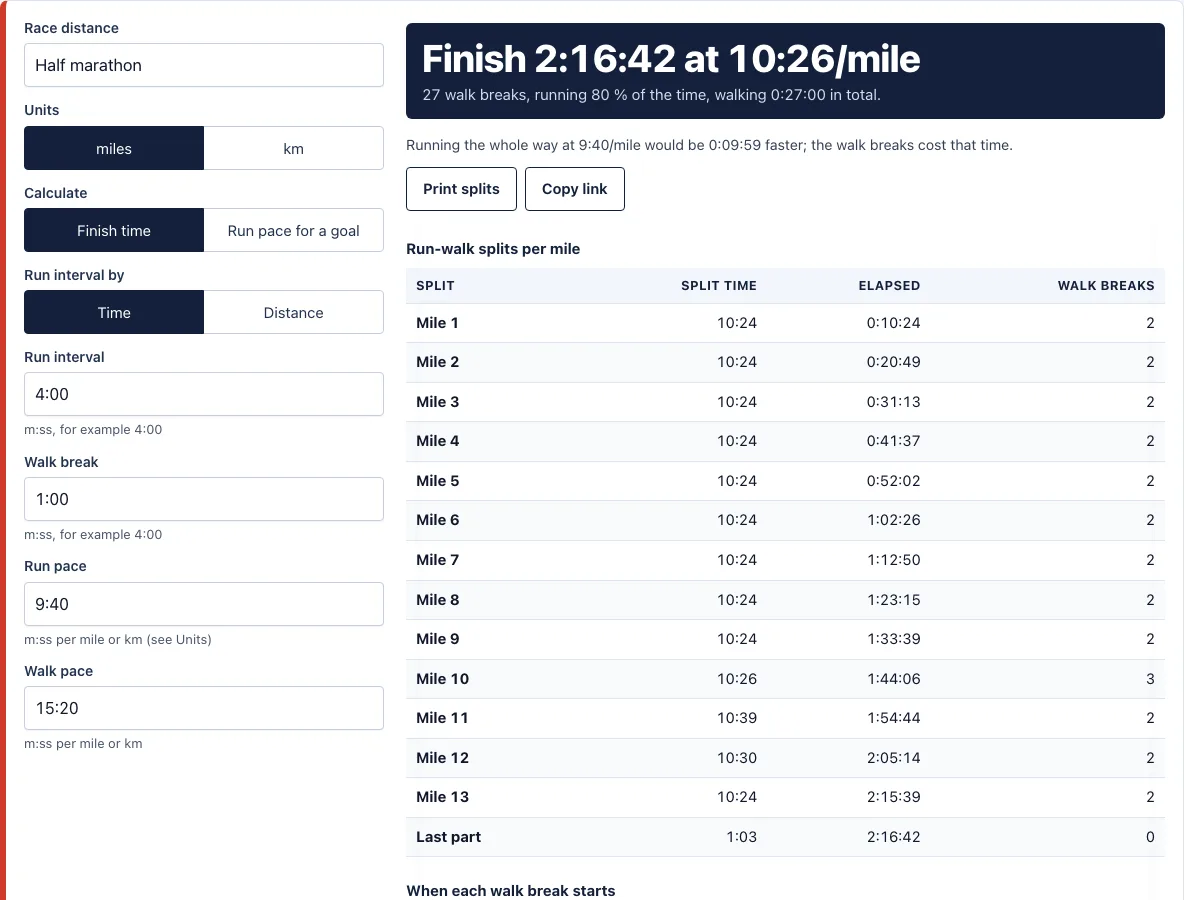
The run share tells you what part of the finish time is running. In the 5K example with 1:00 of running and 1:00 of walking, the run share is 51 % and the walking adds up to 0:20:00. In the 10K example with 2:00 of running and 0:30 of walking it is 80 %, with 0:13:51 of walking. In the half marathon example with 4:00 of running and 1:00 of walking it is 80 %, with 0:27:00 of walking. In the marathon example with 3:00 of running and 1:00 of walking it is 75 %, with 1:09:00 of walking.
What do the walk breaks cost over each distance?
Compare each example with running the whole distance at the run pace. The 5K, at 11:00 per mile running and 16:00 per mile walking, finishes in 0:40:26 against 0:34:11, a difference of 6:15. The 10K, at 6:30 per km running and 10:00 per km walking, finishes in 1:09:51 against 1:05:00, a difference of 4:51. The half marathon, at 9:40 per mile running and 15:20 per mile walking, finishes in 2:16:42 against 2:06:43, a difference of 9:59 with 27 walk breaks. The marathon, at 6:00 per km running and 9:30 per km walking, finishes in 4:38:35 against 4:13:10, a difference of 25:25. The calculator makes no claim that the breaks are better or worse for you; it only puts the cost in minutes next to the plan.
How this tool works and where the numbers come from
Pure arithmetic on the intervals and paces you enter: each run interval is followed by a walk break, repeated from the start; the last interval ends at the finish line. Finish time, average pace, walk-break times and the split band are computed in your browser. No ratios are recommended and no health claims are made.
Sources
Frequently asked questions
Is the calculator tied to a coaching program?
No. Planned walk breaks are a widely used way to run a long distance, and many coaches teach their own version. The calculator is not affiliated with any coach or program; it only does the arithmetic for the intervals you choose.
What are the benefits of the run walk method?
The calculator makes no health claims. What it does show is the cost in time: in the 5K example, the walk breaks add 6:15 to the finish (0:40:26 against 0:34:11), so you can judge a plan from the numbers.
What is a run walk pace calculator?
You enter your run pace and walk pace, and the tool shows your finish time and the time each walk break starts.
How do I choose run and walk intervals for a 10K?
In the 10K example, the plan is 2:00 of running and 0:30 of walking, at 6:30 per km running and 10:00 per km walking. It finishes in 1:09:51 with 28 walk breaks and an average pace of 6:59 per km.
Can I make a run walk plan to print?
Yes. The page gives a split band you can print, and it shows the time each walk break starts so you can follow the plan on the course.
How is the average pace of a run walk plan worked out?
It is the finish time divided by the distance, which blends your run pace and your walk pace by the time spent in each. In the half marathon example the average is 10:26 per mile, between the run pace of 9:40 and the walk pace of 15:20.
Does the calculator tell me which intervals to use?
No. It does not pick a ratio for you. It shows the finish time, average pace and the number of walk breaks for the intervals you enter, and for a goal time it shows the run pace you would need.
Can I plan the walk breaks by distance instead of time?
Yes. Choose whether the interval is set by time or by metres, then enter the run and walk lengths in the same way. The break list then shows where each break starts.
Related tools
- Couch to 5K: Use this for a 9-week plan from walking to a 5K.
- Beginner running plan: Use this for a run-walk plan that builds to 30 minutes of running.
- Pace calculator: Use this to turn a distance and time into a pace.
- Race pace calculator: Use this to turn a goal time into a pace for race day.
- Race time predictor: Use this to predict a time at another distance.
- 5K pace chart: Use this to see split times for your goal 5K time.