
Calories Burned Running Calculator
Enter your weight, how far you ran and how long it took to see the calories you burned.
Free · runs in your browser · nothing is uploaded
Recent
Your last 10 settings, saved only in this browser. Nothing is uploaded.
How to use the running calories calculator
- Choose kg or lb and enter your body weight.
- Choose km or miles and enter the distance you ran.
- Enter the time, as minutes and seconds (30:00) or as hours, minutes and seconds (1:05:00).
- Leave the incline at 0 for flat ground or outdoor running. On a treadmill, enter the incline you used.
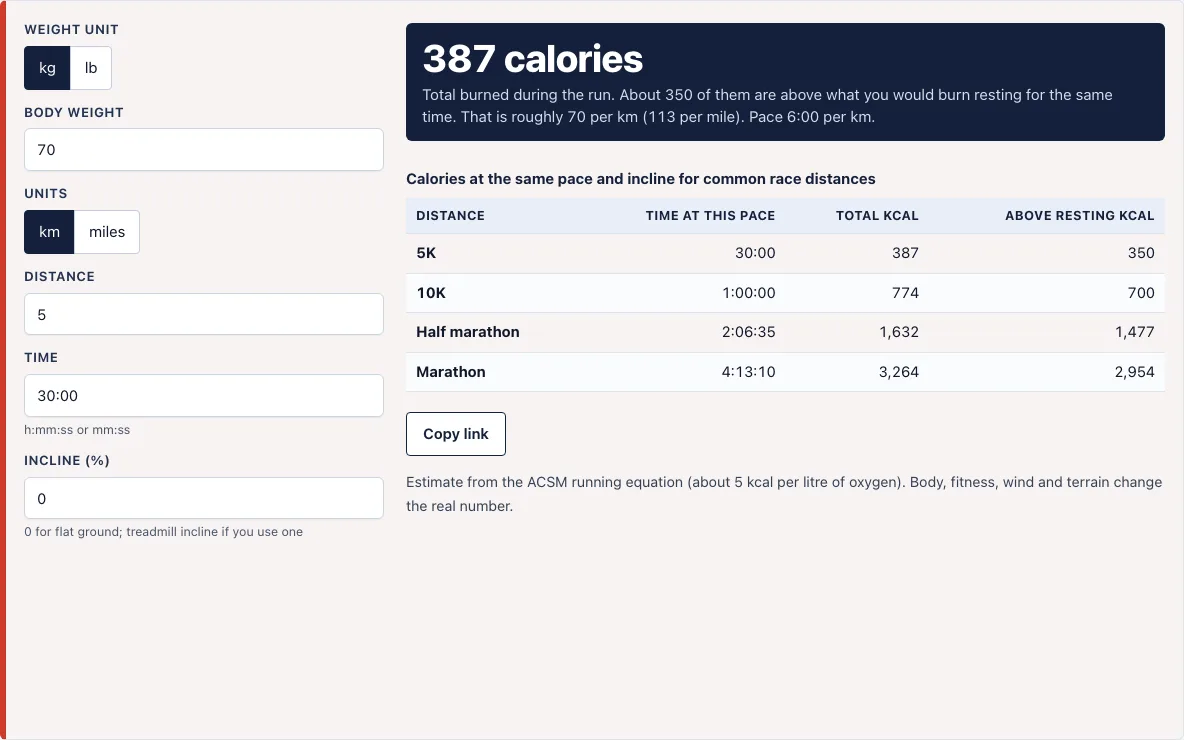
- Read the big number, which is the total calories burned during the run, and the line under it with the calories above resting and the calories per km and per mile.
- Look at the table to see the same pace over longer distances. Press Copy link to keep the exact result.
If you only know your pace, pick a round distance such as 5 km and multiply the pace by it to get the time. The pace is shown under the answer so you can check that it matches your run. The calculator is meant for running speeds. Under about 8 km/h (5 mph) it shows a warning, because the equation fits faster speeds better.
The weight you enter is the only personal number the calculation needs. Age and sex are not used. The distance and time can come from a watch, an app or a treadmill display, and the calculator works out the pace itself. For intervals, enter the total distance and time. The table at the bottom keeps your incline and pace the same, so it answers questions such as how many calories a marathon at your 5K pace would use.
How do I calculate calories burned running?
The calculator uses the ACSM running equation. It turns speed into oxygen use, and oxygen use into energy. Oxygen use in millilitres per kilogram per minute is 0.2 times your speed in metres per minute, plus 0.9 times speed times the incline as a fraction, plus 3.5, which is the resting level. Multiply by your weight in kilograms and the minutes, divide by 1000 to get litres of oxygen, and multiply by about 5 to get kilocalories. For a 70 kg runner at 10 km per hour, the speed is 166.7 metres per minute, so oxygen use is 36.8, which gives 12.9 calories a minute and 774 in an hour. Take away the 3.5 resting level and you get 700, the calories above resting.
How many calories does running a mile burn?
For a 70 kg runner the figure is about 113 calories per mile above resting, which is 70 per km. A good rule of thumb is 1 calorie per kilogram of body weight per kilometre. The total including resting is a little higher: at 9:39 per mile (6:00 per km) it is about 124 per mile. Heavier runners burn more in proportion to weight, so a 90 kg runner burns about 29% more than a 70 kg runner over the same run.
Does running faster burn more calories?
Per minute, yes. Per kilometre, in this equation, the cost above resting stays the same at any speed, because the equation gives each metre the same energy. The total calories including resting per kilometre fall slightly when you run faster, since you spend less time on the run. Running faster burns more in the same time, and running further burns more at the same pace. Incline raises the cost: at 5% the 10 km per hour example above rises from 774 to 931 calories in an hour.
How accurate is a calories calculator?
It is an estimate. The equation was built from average results and your body, fitness, running form, wind, surface and the temperature change the real number. Treat it as a rough guide, and use the same method every time if you want to compare runs. A watch may give a different number because it uses another model, often one that includes your heart rate.
Frequently asked questions
Does the calculator count resting calories?
It shows both. The big number is the total calories burned during the run. The line under it gives the calories above resting, which is the extra energy the run cost compared with sitting still for the same time.
Can I use it for walking?
No. The equation is for running speeds. Under about 8 km per hour the page shows a warning, and for walking the equation can give a figure that is too high.
Does the calculator work with pounds and miles?
Yes. Choose lb for weight and miles for distance. The tool converts to kilograms and metres before it calculates.
How many calories does a 5K burn?
For a 70 kg runner, about 350 calories above resting and about 387 in total at a 6:00 per km pace. The table on the page shows the 5K figure for your own weight and pace.
Do I burn more calories on a treadmill with an incline?
Yes. Entering the incline raises the result. At the same speed, 5% incline costs more energy than flat running, by an amount the equation sets from your speed.
Is this medical or diet advice?
No. It is a general estimate. Talk to a doctor or dietitian before changing your diet for weight loss.
Related tools
- Pace calculator: Use it to work out your pace and finish time.
- Treadmill incline calculator: Use it to see how an incline changes your treadmill pace.
- Running cadence calculator: Use it to check your steps per minute.
- Heart rate zone calculator: Use it to find training zones from your heart rate.
- VO2 max calculator: Use it to estimate your aerobic fitness.
- 5K pace chart: Use it to see the pace for any 5K finish time.
- Methodology: formulas and plan rules: Read the formulas behind the results.