
Training and Tempo Pace Calculator
Enter a recent race to get the paces for every kind of training run.
Recent
Your last 10 settings, saved only in this browser. Nothing is uploaded.
How to use the Training Pace Calculator
- Choose miles or km with the units switch for the headline answer (the table always shows both), and for a custom race distance. Your choice is remembered in this browser.
- Enter the distance of a recent race.
- Enter the finish time for that race.
- Read the six training paces. Each one has a note on what it is used for, such as Easy for most running or Threshold for tempo runs.
- Check the Race Fitness Score shown with the results.
- Click Copy link to share the exact result or save it as a bookmark.
Settings are kept in the page address, so a bookmarked link opens the same result again. On a phone, the tables scroll sideways inside their box.
The units switch sets the unit of the headline answer. The table always shows both per-mile and per-km paces, so changing the switch never loses a value. Copy link is the only button on the page. It saves the exact result, so you can return to the same paces without entering the race again.
Use the Easy pace for most of your running, and keep it relaxed. Use the faster paces only for the sessions their notes name: Threshold for tempo runs of 20-40 minutes, Interval for repeats of 3-5 minutes, and Repetition for short fast repeats of 200-400 m. Marathon pace is for marathon-pace segments.
What pace should my easy runs be?
Easy pace should cover most of your running, and it should feel relaxed enough that you could talk in full sentences. In this tool, easy pace is defined as 15-30% slower than marathon-equivalent pace. The long run is defined as 10-25% slower than that same pace, so it sits in a range that overlaps the easy one.
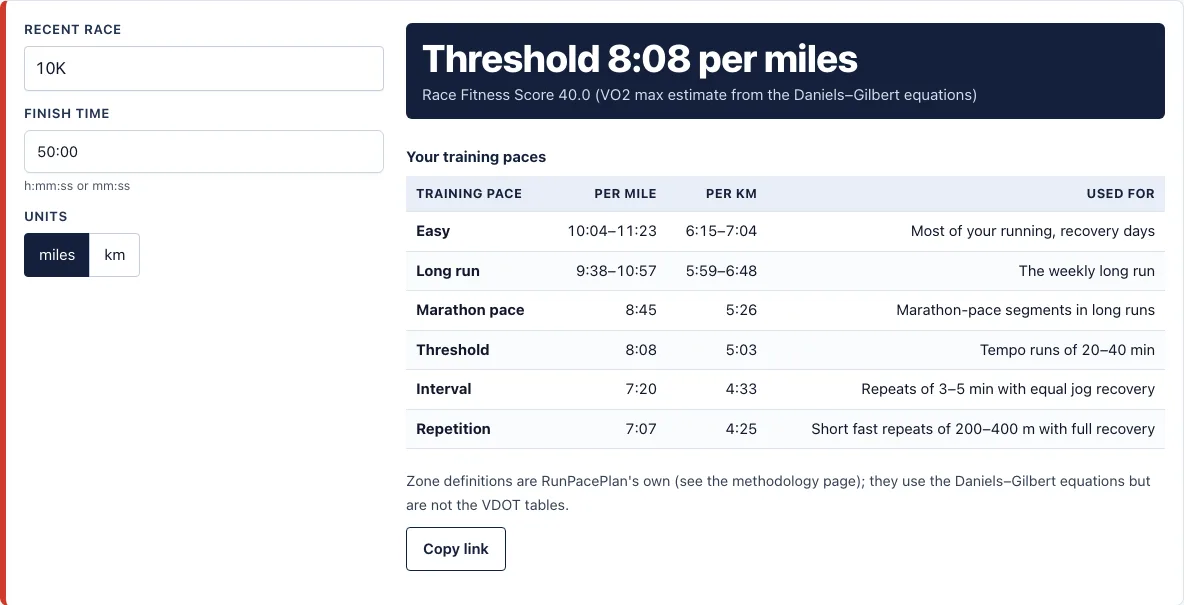
For a 50:00 10K, the tool gives a marathon pace of 8:45/mi. Easy runs come out at 10:04-11:23/mi, and long runs at 9:38-10:57/mi. Keep easy days in the easy range, even when you feel good, because that is where most of the aerobic base is built.
What is tempo pace?
Tempo pace is the threshold pace in this tool. It is the pace you could race for about 60 minutes, and the tool suggests it for tempo runs of 20-40 minutes. Tempo runs are comfortably hard: you can speak only in short phrases.
For the same 50:00 10K, tempo pace is 8:08/mi. The other fast paces follow the same logic at shorter durations. Interval pace is what you could race for about 10 minutes, close to 3K race pace, and is used for repeats of 3-5 minutes. Repetition pace is equivalent to mile race pace and is used for short fast repeats of 200-400 m. For the 10K example, these are 7:20/mi and 7:07/mi.
What is marathon pace in this tool?
Marathon pace is the marathon time equivalent to your race result. The tool uses it for marathon-pace segments, which are runs held at the pace you expect to hold on race day. For the same 50:00 10K, marathon pace is 8:45/mi. That sits between the tempo pace of 8:08/mi and the easy range, so it is a steady effort rather than a hard one.
Which pace should I use for each session?
Each of the six paces has a note on what it is for. Easy covers most of your running, Long run is for your longer runs, Marathon pace is for marathon-pace segments, Threshold is for tempo runs of 20-40 minutes, Interval is for repeats of 3-5 minutes, and Repetition is for short fast repeats of 200-400 m. Choose the pace that matches the session before you start the run, rather than running by feel and checking afterwards.
Frequently asked questions
How do I find my training paces from a race?
Enter the distance and finish time of a recent race, and the tool calculates six training paces from that result. Use a race you ran at close to full effort, because the paces are only as good as the result you enter. Then the paces appear per mile and per km.
Is this a VDOT calculator?
People searching for a VDOT calculator are looking for this kind of tool, and this page works the same way in that it turns a race result into training paces. The calculations are built on the Daniels & Gilbert (1979) equations. “VDOT” is a trademark of The Run SMART Project. This page is not affiliated with VDOT O2 and does not use its tables.
How often should I update my paces?
Update your paces after each new race or time trial. As general advice, many runners refresh them every 4-8 weeks during training, because fitness changes over that time.
Is the race time I enter stored or uploaded?
No. The tool runs entirely in your browser, and nothing you type is uploaded or stored on a server. You do not need an account or sign-up to use it.
Why do easy and long run paces show as ranges?
Each is defined as a percentage slower than marathon pace: easy at 15-30% slower, and long run at 10-25% slower. The range shows the span of that definition, so you can pick a pace within it that suits how you feel that day.
Can I share my paces?
Yes. Click Copy link. Settings are kept in the page address, so the link opens the same result for the person you send it to.
Does the page work on a phone?
Yes. The tables scroll sideways inside their box on small screens.
Related tools
- Race time predictor: use it to estimate what a future race finish time could be.
- Marathon training plan: use it to build a week-by-week plan that uses your paces.
- Heart rate zone calculator: use it if you want to train by heart rate instead of pace.
- VO2 max calculator: use it to estimate your maximal oxygen uptake.
- Race pace calculator: use it to plan the pace for each split of a race.
- Treadmill pace chart: use it to convert pace settings for indoor running.
- Running cadence calculator: Use this to check your steps per minute and set a cadence target.
- mph to minutes per mile: use it to turn a treadmill speed in mph into a pace per mile.
- Methodology: read it for the formulas and plan rules behind the results.