
Treadmill Incline Calculator
Enter speed and incline to see the matching flat-ground pace, or work it backwards.
Recent
Your last 10 settings, saved only in this browser. Nothing is uploaded.
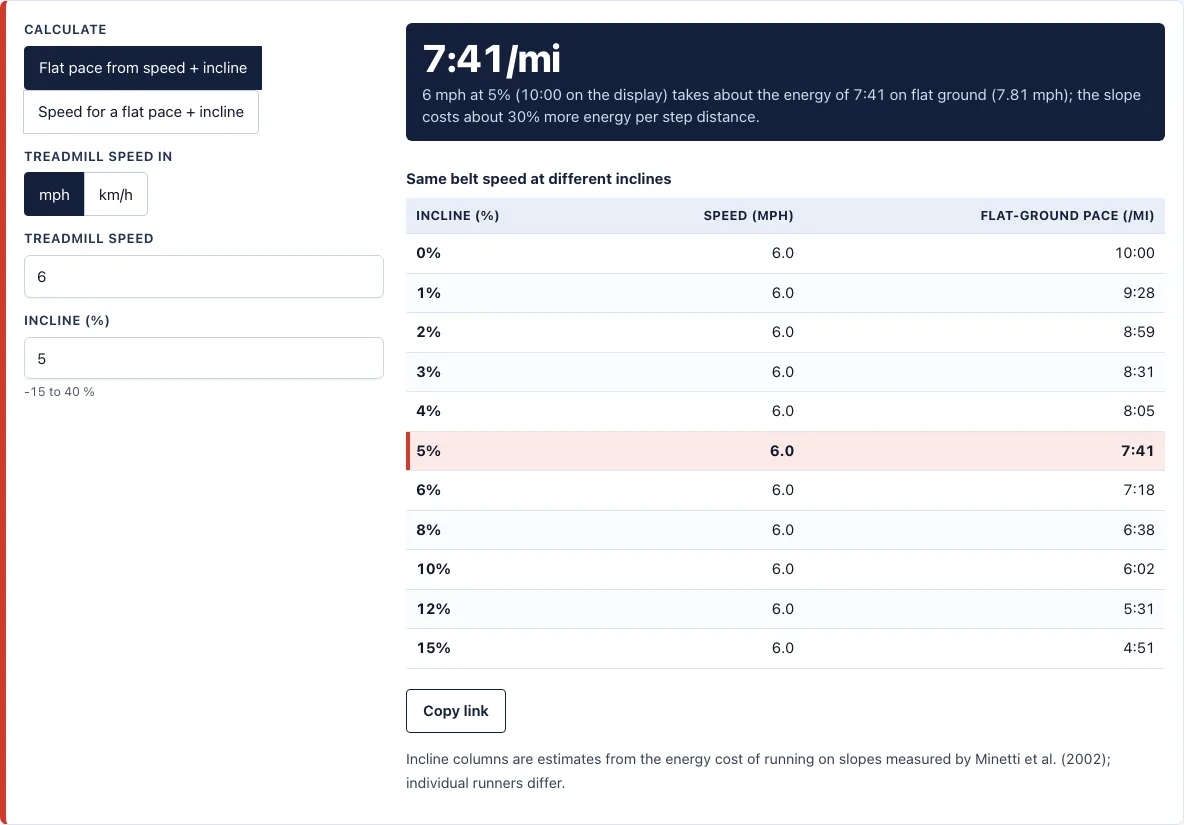
How to use the Treadmill Incline Calculator
- Choose a direction: “Flat pace from speed + incline” or “Speed for a flat pace + incline”.
- For “Flat pace from speed + incline”, enter your treadmill speed and your incline. Incline can be anywhere from -15% to 40%.
- For “Speed for a flat pace + incline”, enter the flat-ground pace you want and the incline.
- Set the speed unit to mph or km/h.
- Paces follow the speed unit: per mile when you choose mph, per km when you choose km/h.
- Read the result. The first direction gives a flat-ground pace. The second gives the belt speed to set on the treadmill.
- Check the table, which shows the same calculation at a range of inclines from 0% to 15%, so you can compare several settings at once.
Your settings are kept in the page address, so the “Copy link” button shares or bookmarks the exact result you are looking at.
Start with the direction that matches your question. If you want to know how hard a treadmill session is compared with a flat run, use the first direction. If you have a flat pace to hold on a hill session, use the second direction to find the belt speed. Both results use the speed unit you selected, so the paces follow it. The table repeats the calculation at 0, 1, 2, 3, 4, 5, 6, 8, 10, 12 and 15%. For any other incline, type it into the calculator directly.
How does incline change treadmill pace?
Incline raises the energy cost of running, so the same speed feels harder and uses more energy on a slope. This tool uses measurements from Minetti et al. (2002), who measured the energy cost of running at gradients from -45% to +45% and fitted this equation: C(i) = 155.4i^5 - 30.4i^4 - 43.3i^3 + 46.3i^2 + 19.5i + 3.6 J/kg/m. Here i is the gradient written as a decimal, so 5% is 0.05.
Flat ground corresponds to C(0) = 3.6. Compared with flat ground, the energy cost is about 30% higher at 5% and about 66% higher at 10%. The tool assumes equal energy use per minute, so the flat-equivalent speed is speed × C(i) / C(0).
For example, 6 mph at 5% matches 7.81 mph on flat ground, which is 7:41/mi. At 10%, 6 mph matches a flat pace of 6:02/mi.
What incline matches running outside?
To mimic outdoor running on a treadmill, set the incline to 1%, which Jones and Doust (1996) suggest to represent air resistance. Outdoors you push against wind and air, and the treadmill belt does not provide that resistance.
Use the flat-equivalent result to compare a treadmill hill effort with flat outdoor running. It shows the flat pace that would use the same energy per minute, so it is the best comparison for effort rather than a prediction of your time on a real hill.
How do I find the speed for a given incline?
Use the “Speed for a flat pace + incline” direction. Enter the flat pace you want, and the tool solves the energy equation backwards to find the belt speed that gives the same energy cost at your chosen incline. In formula form, belt speed = flat speed × C(0) / C(i).
For example, 8:00/mi is 7.5 mph on flat ground. At a 4% incline, the belt speed that matches it is 6.1 mph.
Does downhill work too?
Yes. Enter a negative incline, down to -15%, to calculate a descent. Downhill running lowers the energy cost compared with flat ground, and the cost keeps falling as the slope gets steeper until it reaches about -20%.
Past about -20%, the Minetti data show the energy cost rising again, so very steep descents do not make running easier. The calculator’s -15% limit stays on the part of the curve where the cost is still falling.
Which speed unit does the pace follow?
The pace follows the speed unit you choose. When you pick mph, the pace is shown per mile, and when you pick km/h, it is shown per km. Enter the speed exactly as your treadmill display shows it, so the flat-ground pace comes out in the same unit.
What is the flat-ground equivalent pace?
The flat-ground equivalent is a pace that describes effort, not a time you will run on flat ground. It is the flat pace that uses the same energy per minute as your speed on the incline. A slope costs more energy than flat ground, so the flat-equivalent speed comes out faster than your treadmill speed.
How many steps is a treadmill workout?
Steps equal the distance you cover divided by your step length. The distance is the belt speed times the time, and the incline does not change it. At 2.0 mph for 30 minutes you cover 1 mile, which is 1,609 metres. If your step length is 0.6 metres, that is about 2,682 steps. You can also multiply cadence by minutes: at 100 steps per minute, 30 minutes is 3,000 steps. Step length depends on your height and speed and is shorter when you walk than when you run, so measure your own with the running cadence calculator and use that number instead of the example.
How this tool works and where the numbers come from
The flat-ground equivalent of a treadmill speed at a given incline uses the energy cost of running measured by Minetti and colleagues, fitted as a fifth-degree polynomial of gradient: speed x cost at the incline stays equal to speed x cost on the flat. The values are group averages and are shown as estimates.
Sources
Frequently asked questions
Are the results exact for my own running?
No. The numbers are averages for a group of runners measured in the Minetti study, so they are estimates. Your own energy cost at a given incline can be higher or lower than the average, so treat the result as a guide for effort, not a race prediction.
Does the calculator work on a phone?
Yes, the page works on phones. Tables scroll sideways inside their box on small screens, so you can see every column.
Can I use it for walking?
The equation was fitted to measurements of running, so the results are built on running data. Treat walking results as rough estimates. Use the calculator for running efforts, and treat walking figures as a rough rule of thumb.
Does the table show every incline?
No. The table covers 0, 1, 2, 3, 4, 5, 6, 8, 10, 12 and 15%. For any other incline, enter it in the calculator directly.
Can I enter a 40% incline?
Yes. The calculator accepts inclines from -15% to 40%. The incline table only covers up to 15%, and the Minetti equation was fitted to gradients from -45% to +45%.
Does the calculator include wind?
No. The energy model does not include wind or air resistance outdoors, which is why many runners set a 1% incline on the treadmill.
How do I use the result on the treadmill?
Set the belt speed from the second direction, with the incline you entered. Then compare how the effort feels against your flat target, and adjust the speed in small steps.
Related tools
- Treadmill pace chart: when you want a printable reference of treadmill paces for several speeds.
- mph to minutes per mile: when you need to convert a speed in mph into a pace per mile.
- Pace calculator: when you want to work out pace, time, or distance for a run.
- Training pace calculator: when you want target paces for different types of training.
- Race pace calculator: when you want a steady pace to aim for on race day.
- Heart rate zone calculator: when you want to set effort targets by heart rate.
- Methodology: formulas and plan rules: when you want to see the formulas and plan rules behind the results.