
Treadmill Pace Chart
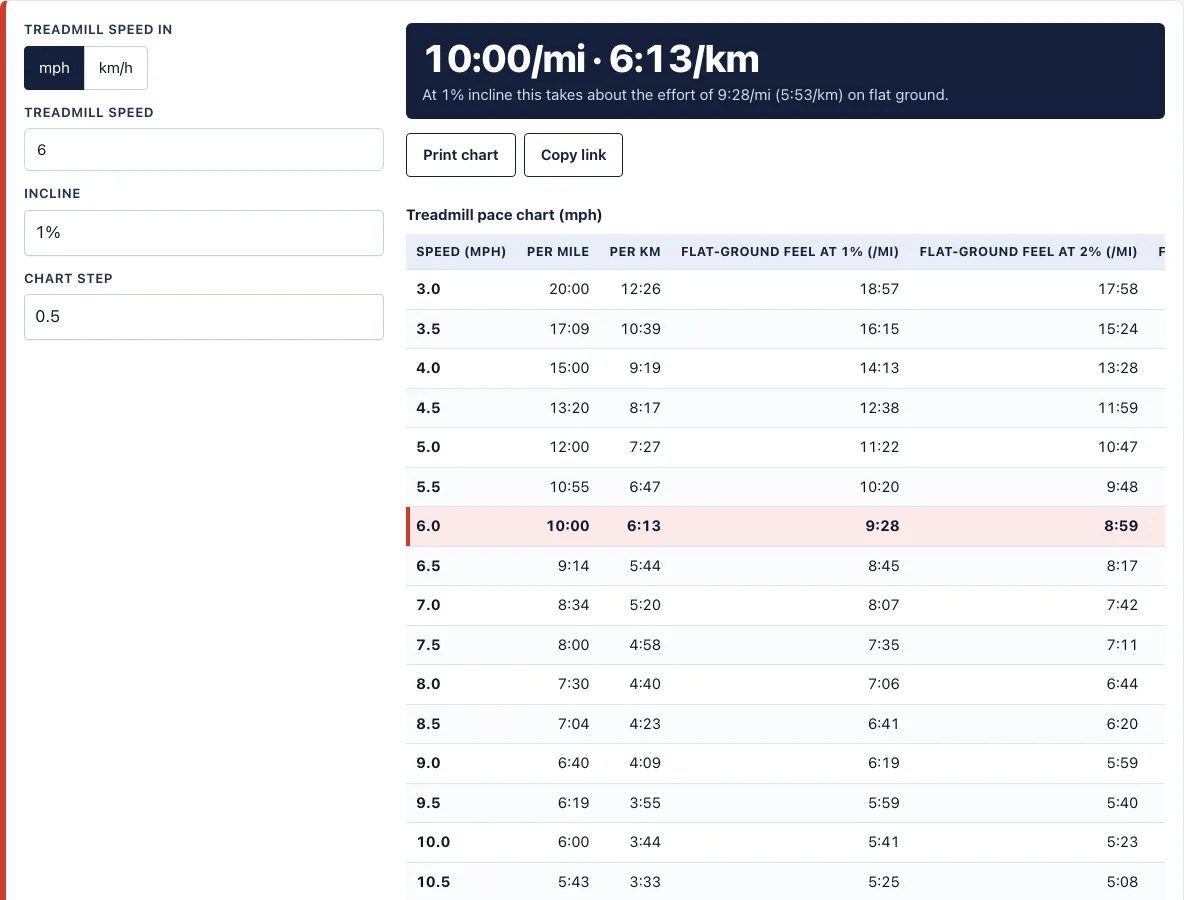
Turn any treadmill speed into pace per mile and per km, with the effect of incline.
| Speed (mph) | Per mile | Per km | Flat-ground feel at 1% (/mi) | Flat-ground feel at 2% (/mi) | Flat-ground feel at 3% (/mi) |
|---|---|---|---|---|---|
| 3.0 | 20:00 | 12:26 | 18:57 | 17:58 | 17:02 |
| 3.5 | 17:09 | 10:39 | 16:15 | 15:24 | 14:36 |
| 4.0 | 15:00 | 9:19 | 14:13 | 13:28 | 12:47 |
| 4.5 | 13:20 | 8:17 | 12:38 | 11:59 | 11:22 |
| 5.0 | 12:00 | 7:27 | 11:22 | 10:47 | 10:13 |
| 5.5 | 10:55 | 6:47 | 10:20 | 9:48 | 9:18 |
| 6.0 | 10:00 | 6:13 | 9:28 | 8:59 | 8:31 |
| 6.5 | 9:14 | 5:44 | 8:45 | 8:17 | 7:52 |
| 7.0 | 8:34 | 5:20 | 8:07 | 7:42 | 7:18 |
| 7.5 | 8:00 | 4:58 | 7:35 | 7:11 | 6:49 |
| 8.0 | 7:30 | 4:40 | 7:06 | 6:44 | 6:23 |
| 8.5 | 7:04 | 4:23 | 6:41 | 6:20 | 6:01 |
| 9.0 | 6:40 | 4:09 | 6:19 | 5:59 | 5:41 |
| 9.5 | 6:19 | 3:55 | 5:59 | 5:40 | 5:23 |
| 10.0 | 6:00 | 3:44 | 5:41 | 5:23 | 5:07 |
| 10.5 | 5:43 | 3:33 | 5:25 | 5:08 | 4:52 |
| 11.0 | 5:27 | 3:23 | 5:10 | 4:54 | 4:39 |
| 11.5 | 5:13 | 3:15 | 4:57 | 4:41 | 4:27 |
| 12.0 | 5:00 | 3:06 | 4:44 | 4:29 | 4:16 |
Recent
Your last 10 settings, saved only in this browser. Nothing is uploaded.
How to use the Treadmill Pace Chart
- Choose your speed unit, mph or km/h, to match your treadmill display.
- Enter your Treadmill speed in that unit.
- Set the Incline, from 0 to 15%. Use 0 if you are running on a flat belt.
- Pick a Chart step: 0.1, 0.2, 0.5 or 1. The smaller the step, the closer together the speeds listed in the table.
- Find your speed in the table. Its row is highlighted, and the columns show pace per mile, pace per km, and the flat-ground equivalent at 1%, 2% and 3% incline.
Press Print chart to print the table, which is useful if you want a paper copy beside the treadmill. Press Copy link to copy a link that holds your exact settings, so you can share or bookmark this result. On a phone, the table scrolls sideways inside its box.
The speed unit comes first because it sets the pace units in the table. Paces are per mile when you choose mph, and per km when you choose km/h. Pick a chart step of 0.1 or 0.2 when you want speeds close together, and 1 when whole speeds are enough. If you want to plan from a pace instead of a speed, use the pace formula in the explanation below, then enter the speed it gives. The row for your speed is highlighted, so you can read across the same line to the pace columns.
How do I convert treadmill speed to pace?
Pace is the time it takes to cover one unit of distance. To get minutes per mile from speed in mph, divide 60 by the speed: pace = 60 / speed. At 5 mph, 60 ÷ 5 = 12, so your pace is 12:00 per mile. At 8 mph, 60 ÷ 8 = 7.5, which is 7:30 per mile.
Faster speeds give shorter paces. Speed is in distance per hour, so 60 divided by that speed gives minutes per unit of distance.
Minutes are not split into hundredths. Take the decimal part and multiply by 60 to get seconds. At 7 mph, 60 ÷ 7 = 8.571 minutes. The 0.571 is about 34 seconds, so the pace is 8:34 per mile.
For pace per kilometre, convert the speed first, because 1 mile is 1.609 km. Multiply mph by 1.609 to get km/h, then divide 60 by that figure. At 5 mph, that is 8.05 km/h, and 60 ÷ 8.05 gives about 7:27 per km. At 8 mph, you run about 12.87 km/h, which gives 4:40 per km.
Should I set the treadmill to 1% incline?
Many runners set 1%, and research supports it as a reasonable choice. Jones and Doust (1996, Journal of Sports Sciences) found that a 1% treadmill grade best matched the energy cost of outdoor running at about 6.5 to 11.2 mph. A flat belt is easier than running outside on most routes, so a small slope brings the effort closer to the road.
The flat-ground equivalent columns show what a slope costs in pace. The estimates come from Minetti et al. (2002, Journal of Applied Physiology), who measured the energy cost of running on slopes. At 6 mph, a 1% incline feels like 9:28 per mile on flat ground, and 3% feels like 8:31 per mile. To use this, set your target effort, compare your flat-ground equivalent to your usual outdoor pace, and choose the incline that matches.
What is the flat-ground equivalent pace?
The flat-ground equivalent is the pace on flat ground that uses about the same energy as your treadmill speed on a given incline. The chart estimates it from the Minetti et al. (2002) measurements. Because individual runners differ, treat each value as a starting estimate rather than a fixed time you will run.
How do I pick a speed for a target pace?
Turn the pace formula around: speed in mph equals 60 divided by the minutes per mile. A target of 10:00 per mile therefore means 6 mph, and a target of 6:00 per mile means 10 mph. Enter the speed you get into the Treadmill speed box to see its row and the matching flat-ground equivalents.
Frequently asked questions
What pace is 6 mph on a treadmill?
At 6 mph you run 10:00 per mile, which is 6:13 per km. Find 6 in the Treadmill speed field, and read the highlighted row for your pace.
Can I print the chart?
Yes. Press the Print chart button to print the table. A printed copy is handy if you want your target paces beside the treadmill during a run.
Does the incline column give my exact pace?
No. The incline columns are estimates, and individual runners differ. Treat the flat-ground equivalent as a starting point, then adjust based on how the effort feels.
Can I use the chart for speeds outside its range?
The chart covers 3 to 12 mph (or 5 to 20 km/h). For any other speed, divide 60 by your speed in mph to get minutes per mile. For example, 4 mph gives 60 ÷ 4 = 15, so 15:00 per mile.
Can I use km/h instead of mph?
Yes. Choose km/h as the speed unit, and the chart covers 5 to 20 km/h, with the pace shown per km.
Does the chart show incline above 3%?
No. The chart’s incline columns cover 1%, 2% and 3%. For a steeper setting, use the treadmill incline calculator, which accepts inclines from -15% to 40%.
Is the chart free to use?
Yes. The tool is free and runs entirely in your browser. Nothing you type is uploaded or stored on a server, and no account or sign-up is needed.
Related tools
- mph to minutes per mile: Use it when you only need one speed converted, rather than a full table.
- Treadmill incline calculator: Use it when you are working out which incline to set for an outdoor effort.
- Pace calculator: Use it for pace questions that are not tied to a treadmill speed.
- Marathon pace chart: Use it to see paces across a range of speeds for a 26.2-mile race.
- 5K pace chart: Use it to plan splits for a 5K race.
- Training pace calculator: Use it to set easy, steady and fast training paces from a recent effort.
- Methodology: formulas and plan rules: Read it to see the formulas and rules behind the pace numbers.