
VO2 Max Calculator
Estimate your VO2 max from a recent race or a 12-minute run.
| VO2 max | 5K | 10K | Half marathon | Marathon |
|---|---|---|---|---|
| 30 | 30:41 | 1:03:49 | 2:21:17 | 4:49:49 |
| 32 | 29:05 | 1:00:27 | 2:13:55 | 4:35:17 |
| 34 | 27:38 | 57:25 | 2:07:17 | 4:22:11 |
| 36 | 26:21 | 54:42 | 2:01:18 | 4:10:19 |
| 38 | 25:10 | 52:15 | 1:55:51 | 3:59:30 |
| 40 | 24:06 | 50:01 | 1:50:54 | 3:49:37 |
| 42 | 23:08 | 47:58 | 1:46:22 | 3:40:33 |
| 44 | 22:14 | 46:06 | 1:42:12 | 3:32:12 |
| 46 | 21:24 | 44:23 | 1:38:21 | 3:24:29 |
| 48 | 20:38 | 42:48 | 1:34:48 | 3:17:19 |
| 50 | 19:56 | 41:20 | 1:31:31 | 3:10:40 |
| 52 | 19:17 | 39:58 | 1:28:28 | 3:04:28 |
| 54 | 18:40 | 38:42 | 1:25:37 | 2:58:40 |
| 56 | 18:05 | 37:31 | 1:22:58 | 2:53:15 |
| 58 | 17:33 | 36:24 | 1:20:28 | 2:48:09 |
| 60 | 17:03 | 35:22 | 1:18:09 | 2:43:22 |
| 62 | 16:34 | 34:23 | 1:15:57 | 2:38:52 |
| 64 | 16:07 | 33:28 | 1:13:54 | 2:34:37 |
| 66 | 15:42 | 32:36 | 1:11:57 | 2:30:37 |
| 68 | 15:18 | 31:47 | 1:10:07 | 2:26:49 |
| 70 | 14:56 | 31:01 | 1:08:23 | 2:23:13 |
| 72 | 14:34 | 30:17 | 1:06:44 | 2:19:48 |
| 74 | 14:14 | 29:35 | 1:05:10 | 2:16:33 |
| 76 | 13:54 | 28:56 | 1:03:42 | 2:13:28 |
| 78 | 13:36 | 28:18 | 1:02:17 | 2:10:31 |
| 80 | 13:18 | 27:42 | 1:00:57 | 2:07:43 |
Recent
Your last 10 settings, saved only in this browser. Nothing is uploaded.
How to use the VO2 max calculator
- Choose a method: A race result or Cooper 12-minute test.
- For a race result, enter the race distance and your finish time. For the Cooper test, enter the distance you covered in 12 minutes, in metres, miles or km.
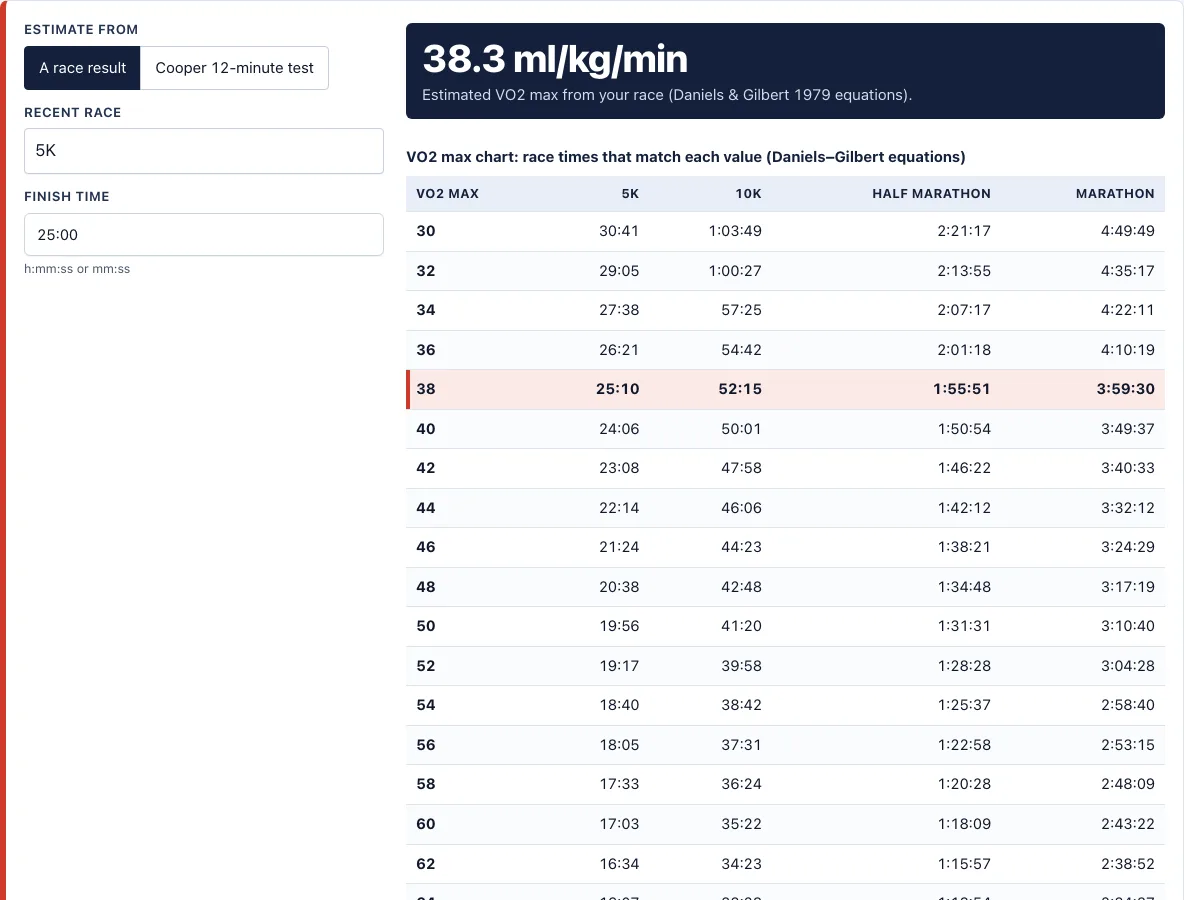
- Read your VO2 max estimate, then find the highlighted row on the VO2 max chart to see the race times that match your value.
- Click Copy link to share or bookmark the exact result. Your settings are kept in the page address, so the link reopens the same calculation.
Pick the method that matches an effort you can measure. The race method needs a finish time from a race, or a hard time trial, that you ran at full effort. The finish time is the number that drives the estimate, so a race you paced easily will give a lower value than the same course run flat out. The Cooper test needs a 12-minute run on a measured course, where you cover as much distance as you can.
The VO2 max chart runs from 30 to 80. Each row pairs a VO2 max value with the 5K, 10K, half marathon and marathon times that match it, and your value is highlighted.
Repeat the calculation after a new race or test rather than comparing two single runs as if they were measurements. The page works on phones. On small screens, the chart scrolls sideways inside its box.
How do I calculate my VO2 max from a race?
The race method uses the Daniels and Gilbert equations from 1979. It works out the oxygen cost of running at your average speed, then divides that cost by the share of VO2 max you can hold for your finish time.
First, convert your speed to metres per minute (v). The oxygen cost is:
VO2 = -4.60 + 0.182258v + 0.000104v²
Second, the fraction of VO2 max you can sustain for t minutes is:
0.8 + 0.1894393e^(-0.012778t) + 0.2989558e^(-0.1932605t)
Your VO2 max estimate is the oxygen cost divided by that fraction. Shorter races are run at a higher share of VO2 max, so the divisor is larger for them. The chart uses the same equations, so each value and its matching race times always agree.
For example, a 10K in 40:00 gives v = 250 m/min. The oxygen cost is about 47.5, the fraction is about 0.914, and the estimate is 51.9 ml/kg/min. A marathon in 4:00:00 gives 37.9 ml/kg/min.
What is the Cooper test?
The Cooper test is a 12-minute run in which you cover as much distance as you can at a steady, hard effort. Cooper (1968, JAMA) published a formula that turns that distance into a VO2 max estimate:
VO2 max = (metres in 12 minutes - 504.9) / 44.73
Running 2,400 m gives 42.4 ml/kg/min, and 2,800 m gives 51.3. The tool accepts your distance in metres, miles or km. The formula uses only the distance you cover, so the result depends on how well you pace the full 12 minutes.
How accurate are VO2 max estimates?
These are estimates based on your race or test performance, not direct measurements. A lab test measures oxygen use directly, while a race or field test can only be as good as the performance it uses. Two runners with the same finish time can have different running economy, so the same race time does not always reflect the same underlying fitness.
Can I improve my VO2 max?
Training is the main lever. Interval sessions at about 3K to 5K race effort are commonly associated with higher VO2 max. Losing excess weight is also commonly associated with a higher value. Because the estimate comes from race or test performance, a new result is the way to see whether the number has moved.
How this tool works and where the numbers come from
VO2 max from a race time divides the oxygen cost of the running speed by the fraction of maximum uptake a runner can hold for that long (Daniels and Gilbert equations). From a 12-minute run it uses the Cooper test: (metres - 504.9) / 44.73. Both are estimates, not a lab test.
Sources
Frequently asked questions
What is a good VO2 max?
The page does not show VO2 max ratings by age or sex, so it cannot tell you whether your value is good for your group. Use the VO2 max chart instead to see what each value corresponds to in 5K, 10K, half marathon and marathon times.
What does VO2 max measure?
VO2 max is the greatest rate at which your body can take in and use oxygen during hard exercise. It is measured in millilitres of oxygen per kilogram of body weight per minute.
Which race distances can I enter?
You can enter any race distance with its finish time. The page’s examples and chart cover 5K, 10K, half marathon and marathon times. The examples use a 10K, a 5K and a marathon, so you can see how the same method treats different distances.
Which method should I use?
Use the race result method if you have a recent race time you ran at full effort. It is the better choice for a recent 5K, 10K, half marathon or marathon, because the chart covers those distances. Use the Cooper test if you can run flat out for 12 minutes on a measured course and want a field test.
Is my data stored?
No. The tool runs entirely in your browser, so nothing you type is uploaded or stored on a server. No account or sign-up is needed.
Does the page work on a phone?
Yes. The page works on phones, and on small screens the chart scrolls sideways inside its box.
Related tools
- Race time predictor: Use it to estimate race times at other distances from a known performance.
- Training pace calculator: Use it to turn your fitness into pace targets for easy, steady and hard sessions.
- Heart rate zone calculator: Use it to set training zones from your heart rate values.
- Max heart rate calculator: Use it to estimate your maximum heart rate before setting zones.
- 5K pace chart: Use it to see the pace needed for each 5K finish time.
- Zone 2 heart rate calculator: Use it to find the heart rate range for easy, aerobic running.
- Methodology: formulas and plan rules: Use it to read the full formulas and rules behind the tools on this site.