
Zone 2 Heart Rate Calculator
Find your zone 2 heart rate range from your age, resting and maximum heart rate.
Recent
Your last 10 settings, saved only in this browser. Nothing is uploaded.
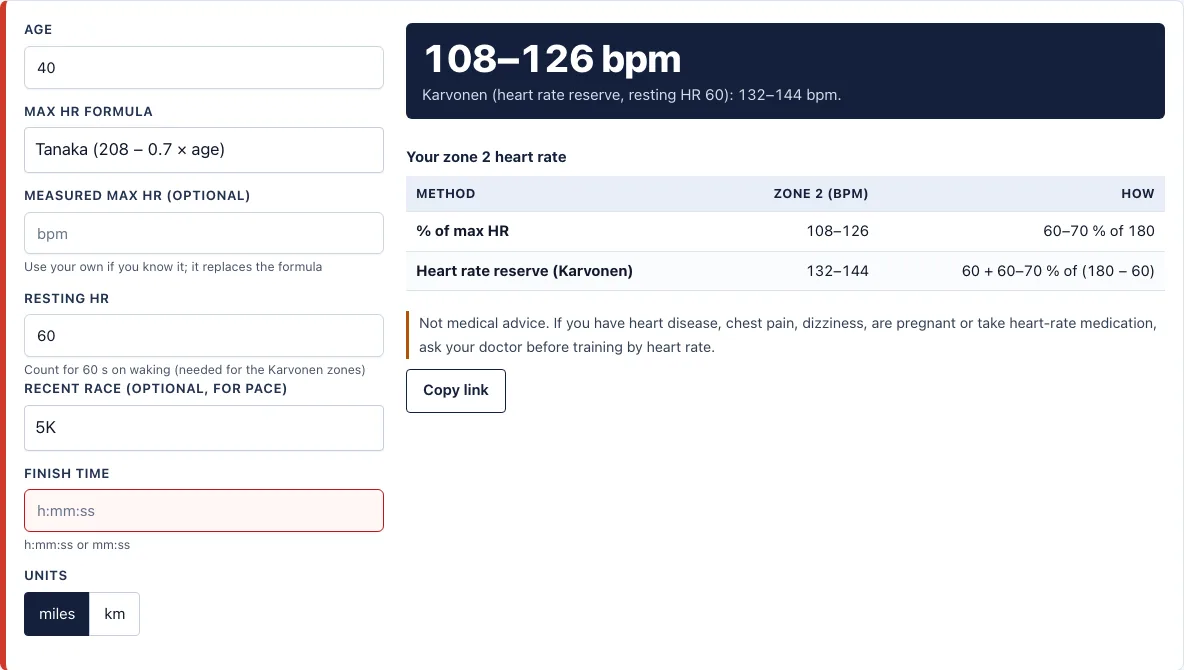
How to use the Zone 2 heart rate calculator
- Enter your age.
- Choose a max HR formula, or enter a measured max HR if you have one. The measured value is optional.
- Enter your resting heart rate.
- Optionally, enter a recent race result by typing the distance and time.
- Choose units: miles or km.
- Read your zone 2 range, both the 60-70% of max HR version and the Karvonen version.
- If you entered a race result, read the easy pace range.
- Click Copy link to share or bookmark the exact result.
The miles / km switch changes every pace and distance, and your choice is remembered in this browser. Settings are kept in the page address, so the Copy link button saves the exact result you are looking at. The page works on phones, and tables scroll sideways inside their box on small screens.
Choose the max HR formula first, then decide whether to add a measured max. The measured value is optional, so leave it empty if you do not have a reliable number from a hard, all-out effort. Your zone 2 range is then built from the value the page uses.
The page gives you two ranges. The simple range is 60-70% of your max heart rate. The Karvonen range also needs your resting heart rate, so enter it if you want the second range.
The race result is optional. When you enter a distance and time, the page adds an easy pace range from the training pace calculator.
What is zone 2 heart rate?
Zone 2 heart rate is the range of beats per minute you reach during an easy, conversational effort. At this intensity you can speak in full sentences, and the work is light enough that you could keep going for a long time.
Easy, steady work like this builds aerobic endurance, which is your ability to keep moving for long periods. Many training plans use zone 2 for most of the easy running, with harder sessions kept as a smaller share.
Heart rate zones are a way to label effort. Zone 2 sits below the point where breathing becomes hard and talking breaks up into short phrases. If you can’t tell whether you are in zone 2, the talk test works as a backup.
How do I calculate my zone 2 heart rate?
You can calculate zone 2 in two ways: as 60-70% of your max heart rate, or with the Karvonen method, which also uses your resting heart rate. Both need a max heart rate, which you can estimate from your age with a formula or measure directly.
The tool’s default formula is Tanaka, which estimates max heart rate as 208 minus 0.7 times your age. For a 40-year-old, that gives 180 bpm. A measured max heart rate is usually more accurate than any formula, so the tool accepts one when you have it.
The simple method multiplies max heart rate by 60% and 70%. With a max of 180, that gives 108-126 bpm. For a 30-year-old with a Tanaka max of 187, the zone is 112-131 bpm.
The Karvonen method starts from your resting heart rate and works on the gap between rest and max, called the heart rate reserve. With a resting heart rate of 60 and a max of 180, the reserve is 120. Then 60% of 120 plus 60 gives 132, and 70% of 120 plus 60 gives 144. The result is 132-144 bpm, which is higher than the simple method for the same person. Pick one method and stick with it, so your ranges stay comparable from week to week.
Why is zone 2 training so slow?
Zone 2 feels slow because it is meant to be easy. At first, many runners find the pace is slower than they expect, and some need to walk on hills to stay in range. That is normal, and it is the point of the work: the effort stays easy while the heart rate stays low.
Heart rate also drifts upward during long runs and in heat. The same pace may then push your heart rate above zone 2 by the end of a run, so your pace at the same heart rate gets slower. That is expected.
What pace is zone 2?
Zone 2 pace depends on your fitness, so it is best found from a recent race. Enter a race result in the calculator to get an easy pace range from the training pace calculator. For example, a 25:00 5K gives an easy pace of 10:26-11:48 per mile.
Because the pace range comes from a race, a recent result gives a better estimate than an old one. Your easy pace changes as your fitness changes, so recheck the range after a new race.
Frequently asked questions
How much running should be in zone 2?
Most of your easy running can sit in zone 2, with harder sessions kept as a smaller share. The exact split depends on your goals and how much you train, so treat it as a starting point rather than a fixed rule.
Is a chest strap more accurate than a watch for zone 2?
Usually, yes. Chest straps are generally more accurate than wrist optical sensors during running, so they give a steadier reading to train by.
Should I check with a doctor before training by heart rate?
Yes, if you have heart disease, chest pain or dizziness, if you are pregnant, or if you take medication that affects heart rate. Ask a doctor before training by heart rate in those cases. Stop exercising and seek help if you feel chest pain or dizziness.
Does the calculator store what I enter?
No. The tool runs entirely in your browser, so nothing you type is uploaded or stored on a server. No account or sign-up is needed. Your settings are kept in the page address, so the Copy link button shares the exact result.
Does the page work on a phone?
Yes. The page works on phones. On small screens, tables scroll sideways inside their box, so you can read the full range on a small screen without leaving the page.
Does the miles / km switch change my heart rate range?
No. The switch changes every pace and distance shown, and your choice is remembered in this browser. The heart rate ranges are in beats per minute either way.
Related tools
- Heart rate zone calculator — use it to see the full set of heart rate zones, not just zone 2.
- Max heart rate calculator — use it to compare max heart rate formulas before you enter one here.
- Training pace calculator — use it to work out training paces from a race result.
- Beginner running plan — use it if you are new to running and want easy runs built into a weekly schedule.
- Marathon training plan — use it if you are preparing for a marathon and need easy running in a longer plan.
- VO2 max calculator — use it to estimate your aerobic fitness from a race or test result.
- Methodology: formulas and plan rules — use it to see exactly which formulas and rules sit behind these results.